What to Look for When Selecting LED House Lights

When you choose Perfect LED House Lights, consider factors like brightness, color temperature, compatibility, energy use, quality, and price. Almost half of homes in the U.S. now utilize LED lights for most rooms. Selecting the right LED light for each area of your Home enhances the mood and conserves energy.
Warm light (2000K–3000K): ideal for bedrooms or living rooms
Neutral white (3500K–4500K): suitable for kitchens or offices
Cool light (5000K–6500K): perfect for studies or gyms
You can rely on About Us for valuable tips that assist you in making the best product choices.
Key Takeaways
Look at lumens, not watts. Lumens show how bright the light is. Watts show how much energy the bulb uses. Pick LED bulbs that give more lumens but use less energy.
Pick the right color temperature for each room. Warm light (2700K) helps you relax. Cool light (4000K-5000K) helps you focus and work better.
Make sure the bulbs fit your fixtures and dimmers. Check that your LED bulbs work with your current systems. This will stop flickering or bad lighting.
Brightness and Lumens
Lumens vs. Watts
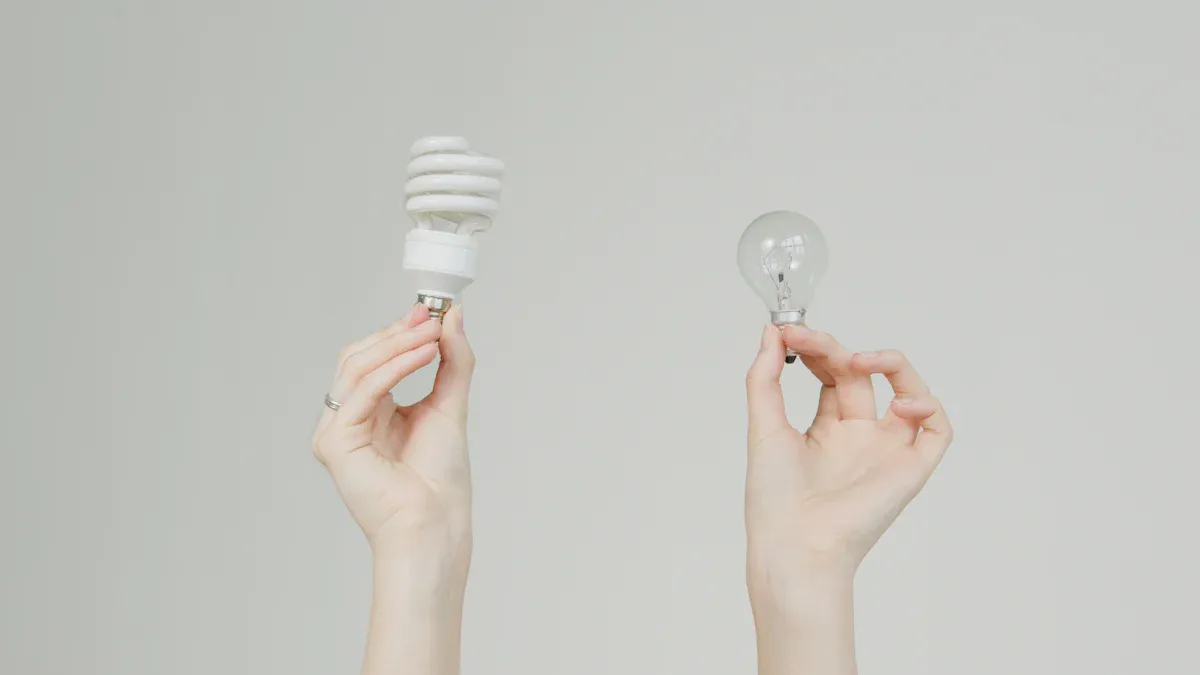
When you shop for LED house lights, you might see both lumens and watts on the packaging. Lumens tell you how bright the light will be. Watts show how much energy the bulb uses. You want to focus on lumens because they measure the actual light output. LED bulbs give you more lumens for every watt compared to old incandescent bulbs.
Watts are not a measure of light output. Rather, they are a measure of how much energy a light source is consuming. The unit of measurement to determine how much light a lamp or luminaire emits is called lumens.
Here’s a quick list to help you remember:
Lumens measure brightness.
Watts measure energy use.
LED lights provide more lumens per watt.
Brightness by Room
Each room in your house needs a different amount of lumens. Living rooms and bedrooms feel cozy with softer lighting, while kitchens need brighter lights for cooking and cleaning. Check out this table for the optimal brightness levels:
Room Type | Optimal Brightness (Lux) | Optimal Brightness (Lumens) |
|---|---|---|
Living Room | 50-150 | 500 |
Bedroom | 50-150 | 375 |
Kitchen | 150 | 375 |
You can also look at industry standards for general household lighting:
Area | Recommended Lumens |
|---|---|
General residential | 30 – 50 lumens |
Living areas | 10 – 20 lumens/ft² |
Bedrooms and lounges | 10 – 20 lumens/ft² |
Setting Lumen Targets
You want to make sure each space gets the right amount of lumens. Start by thinking about how you use the room. For example, a kitchen needs more lumens for tasks, while a bedroom needs fewer lumens for relaxation.
To calculate required lumens, use the IES foot candle guide. Multiply the foot candle value by the area in square feet. This helps you set the perfect target for each room.
A good lighting plan uses layers. General lighting gives overall brightness, task lighting helps with activities, and accent lighting highlights special features. This way, you get the right amount of lumens for every activity.
Color Temperature Choices
Warm vs. Cool Light
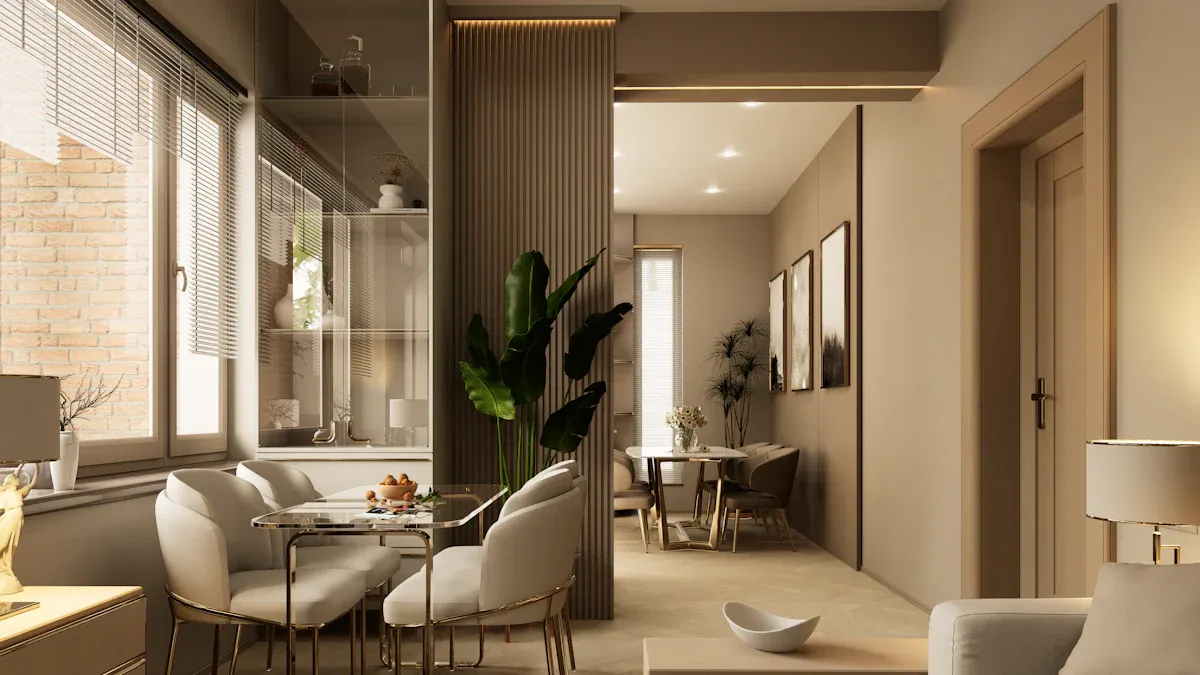
You might wonder why some rooms feel cozy while others seem bright and alert. The secret is color temperature. Warm light, which falls between 2200K and 3000K, gives your space a soft, golden glow. This type of lighting helps you relax and unwind, making it perfect for bedrooms and living rooms. Cool light, on the other hand, ranges from 4000K to 5000K or more. It looks crisp and clear, so you stay focused and energized. You’ll notice cool light works best in places where you need to concentrate, like your home office or kitchen.
Tip: Warm light creates a welcoming vibe, while cool light boosts your energy and focus.
Best Temperatures for Each Room
Choosing the right color temperature for each room makes a big difference. Here’s a quick guide:
Bedroom: Around 2,700K for a relaxing feel.
Kitchen: 4,000K to 5,000K for better visibility and productivity.
Bathroom: 3,500K to 4,500K for clear, comfortable lighting.
Office: 4,000K to 5,000K to help you concentrate.
Check out this table for a simple overview:
Room Type | Recommended Color Temperature | Effect on Ambiance |
|---|---|---|
Bedroom | Warm (2700-3000K) | Cozy, relaxing atmosphere |
Kitchen/Bathroom | Neutral (3500-4500K) | Good visibility and comfort |
Office | Cool (4000-5000K) | Focus and efficiency |
Ambiance and Activity
Color temperature shapes how you feel and what you do in each room. Warm colors make spaces feel inviting and help you wind down after a long day. Neutral tones in kitchens and bathrooms give you clear light for tasks like cooking or getting ready. Cool colors in offices keep you alert and productive. When you match the light to your activity, you create the perfect mood for every space. 🌟
Finding the Perfect LED House Lights
Matching Features to Needs
You want your home to feel comfortable and look great. To do that, you need to balance several features when searching for the perfect led house lights. Think about brightness, color temperature, compatibility, energy efficiency, quality, and cost. Each factor plays a role in how your space feels and functions.
Here’s a table to help you compare what matters most:
Criteria | Description |
|---|---|
Brightness | Measured in lumens. Each room needs a different level for the best results. |
Color Temperature | Measured in kelvins. Warm tones help you relax. Cool tones keep you alert for tasks. |
Compatibility | Make sure your lights work with your fixtures and dimmers. |
Energy Efficiency | Choose bulbs that give you more light for less energy. |
Quality | Pick brands with good reviews. Quality bulbs last longer and perform better. |
Cost | Think about both the price now and the savings later from lower energy bills. |
You might wonder how to match these features to your daily needs. If you read a lot, you need task lighting that is bright and focused. Cooking calls for strong, clear light in the kitchen. Relaxing in the living room feels better with soft, warm light. Task lighting helps you see better and keeps your eyes comfortable. Desk lamps, under-cabinet lights, and pendant lights above workspaces are great choices for these activities.
Tip: The perfect led house lights make every activity easier and every room more inviting.
Many people make mistakes when choosing lights. They forget accent lighting, pick fixtures that don’t fit the room, or mix different color temperatures. Sometimes, they place lights in the wrong spot or choose the wrong size. These mistakes can make your home look odd or feel uncomfortable. You want harmony and balance, so pay attention to style, placement, and color.
Room-by-Room Tips
Every room has its own purpose, so you need the perfect led house lights for each space. Let’s break it down:
Room | Purpose | Brightness (Lumens) | Color Temperature (K) |
|---|---|---|---|
Living Room | Relaxation and entertainment | 1,500 - 3,000 | 2700 |
Kitchen | Cooking and meal prep | 4,000 - 8,000 | 4000 - 5000 |
Bedroom | Unwinding | 1,000 - 2,000 | 2700 - 3000 |
Bathroom | Grooming and hygiene | 7,000 - 8,000 | 3500 - 4500 |
You want the best led lights for each area. In the living room, soft light helps you relax and watch TV. In the kitchen, bright and cool light makes cooking safer and easier. Bedrooms need gentle light for winding down. Bathrooms work best with clear, neutral light for grooming.
Here are some quick tips for finding the perfect led house lights in every room:
Use desk and table lamps for reading and homework.
Try under-cabinet lighting in the kitchen for meal prep.
Hang pendant lights above counters or workspaces.
Place reading lamps near beds or sofas.
Note: Even the best led lights won’t work well if you put them in the wrong spot or pick the wrong style.
You want to avoid common mistakes. Don’t mix warm and cool lights in the same room. Make sure your fixtures match your décor. Place lights at the right height to prevent glare. Spread out your lights so you don’t get dark corners or harsh shadows.
When you balance brightness, color, compatibility, efficiency, quality, and cost, you create the perfect led house lights for your home. You get comfort, style, and savings all at once. The best led lights help you enjoy every moment, whether you’re working, relaxing, or spending time with family.
Compatibility and Dimming
Fixture Requirements
When you switch to LED house lights, you want everything to fit and work smoothly. Sometimes, you run into problems with older fixtures. Maybe the socket size does not match, or the bulb sits awkwardly in the holder. You might notice the light does not spread evenly across the room. Some fixtures designed for incandescent or fluorescent bulbs just do not play well with LEDs.
Here are a few things you should check before buying new bulbs:
Make sure the socket type and size match your LED bulb.
Look at the fixture’s wattage rating. Using a bulb with too high wattage can cause problems.
Check if the bulb fits snugly in the holder. A loose fit can lead to flickering or poor light distribution.
Sometimes, you need to modify the fixture, like changing the socket or removing a ballast.
Tip: Always consider the beam angle of your LED bulb. A narrow beam can cause glare, while a wide beam gives softer light.
Dimmable LEDs
Do you want to adjust the brightness in your room? Dimmable LEDs let you control the mood and save energy. But not all dimmers work with LED bulbs. Older dimming systems can cause flickering, buzzing, or even make the bulb fail to light up.
Here’s a quick table to help you spot dimming issues:
Problem | Possible Cause | Solution |
|---|---|---|
Flickering | Incompatible dimmer | Upgrade to LED-compatible dimmer |
Buzzing | Old dimmer technology | Use modern dimmer switch |
Won’t light up | Wrong wiring or fixture type | Check wiring and fixture specs |
You want to check your dimmer’s compatibility before installing new bulbs. If you get it right, you can enjoy smooth, adjustable lighting in every room. 😊
Energy Efficiency and Savings
Energy Ratings
You want lights that use less power but shine brighter. LED house lights are better because they give more light for each watt. Look at this table to see how different bulbs compare:
Light Bulb Type | Lumens per Watt | Energy Efficiency Comparison |
|---|---|---|
Incandescent Bulbs | ~15 | Baseline (least efficient) |
CFLs | ~60 | 4 times more efficient than incandescent |
LED Bulbs | ~100 (varies) | 7 times more efficient than incandescent, 40%-50% more than CFLs |
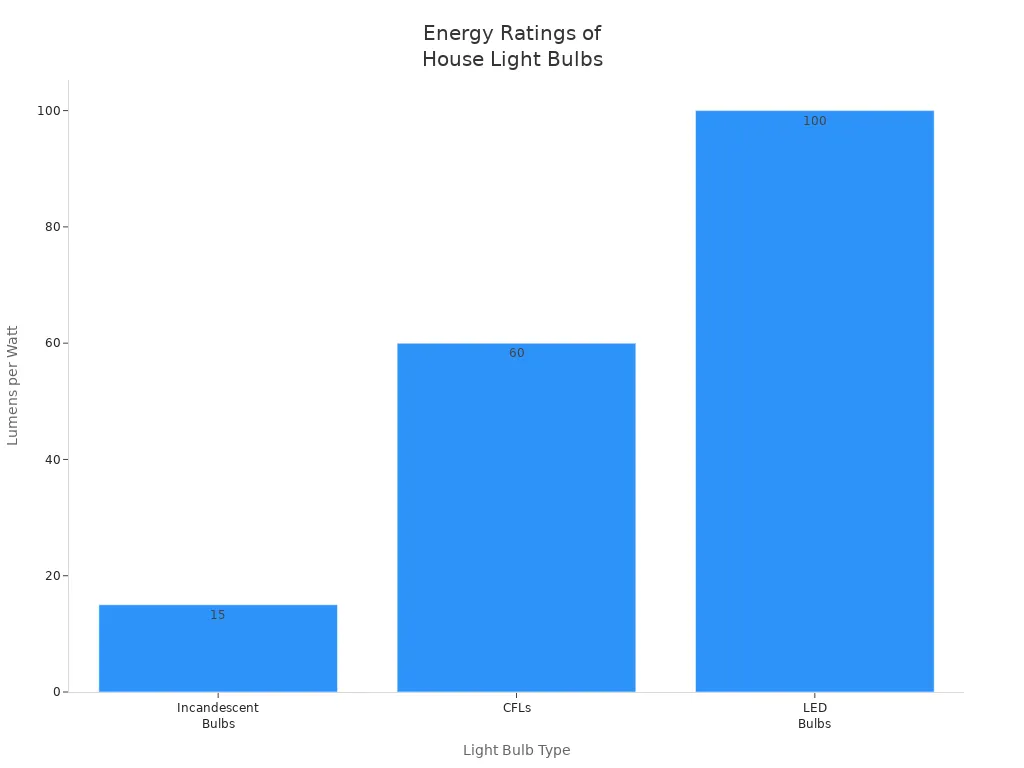
LED bulbs help you save energy and pay less for electricity. You get more light for every watt you use.
Certifications
When you buy LED house lights, check for special labels. These show your bulbs are safe and save energy. Here’s a quick guide:
Certification | Description | Importance |
|---|---|---|
UL | Recognized safety certification for lighting products in the U.S. and Canada. | Reduces electrical hazards in installations. |
Energy Star | U.S. government-backed certification for energy efficiency. | Ensures significant energy savings and high quality. |
CE | Indicates compliance with EU safety and environmental standards. | Ensures safety and environmental compliance in Europe. |
RoHS | Limits hazardous materials in electrical products. | Ensures safety for users and the environment. |
FCC | Ensures compliance with electromagnetic interference limits. | Prevents interference with other electronic devices. |
DLC | Focuses on high-efficiency commercial lighting products. | Promotes energy efficiency and potential utility rebates. |
Tip: Pick bulbs with the Energy Star label for the best savings and quality.
Calculating Savings
Switching to LED house lights can save you lots of money each year. Here’s what you might see:
Most homes have about 40 bulbs.
Each 60-watt incandescent bulb costs $7–8 a year.
If you use 9-watt LEDs, it drops to $1 per bulb.
You could save $250–$300 every year.
You get brighter rooms, lower bills, and better energy use. That’s good for your wallet and the planet! 💡
Quality and Longevity
Spotting Quality LEDs
You want your lights to look great and last a long time. High-quality LED house lights have some clear signs. Look for a Color Rendering Index (CRI) above 80. This means colors in your room will look natural and bright. Check the color temperature, measured in Kelvins. Warm light (2700K) feels cozy, while cool light (6000K) helps you focus. Good LEDs last between 25,000 and 50,000 hours, so you won’t need to change bulbs often. ENERGY STAR certification shows the bulb saves energy and meets strict standards. Dimmable and flicker-free bulbs make your space more comfortable.
Here’s a quick list to help you spot quality LEDs:
CRI rating of Ra90+ for true colors
Color temperature that matches your room’s mood
ENERGY STAR label for efficiency
Dimmable and flicker-free features
Brand and Warranty
Choosing a trusted brand gives you peace of mind. Many top brands offer warranties from 5 to 10 years. If your bulb stops working during the warranty, you usually get a free replacement. Litetronics gives up to 10 years, while other brands offer 3 to 5 years.
Brand | Warranty Period |
|---|---|
Litetronics | Up to 10 years |
Other Brands | 3 to 5 years |
Tip: Always check the warranty before you buy. A longer warranty means the company stands behind its product.
LED Lifespan
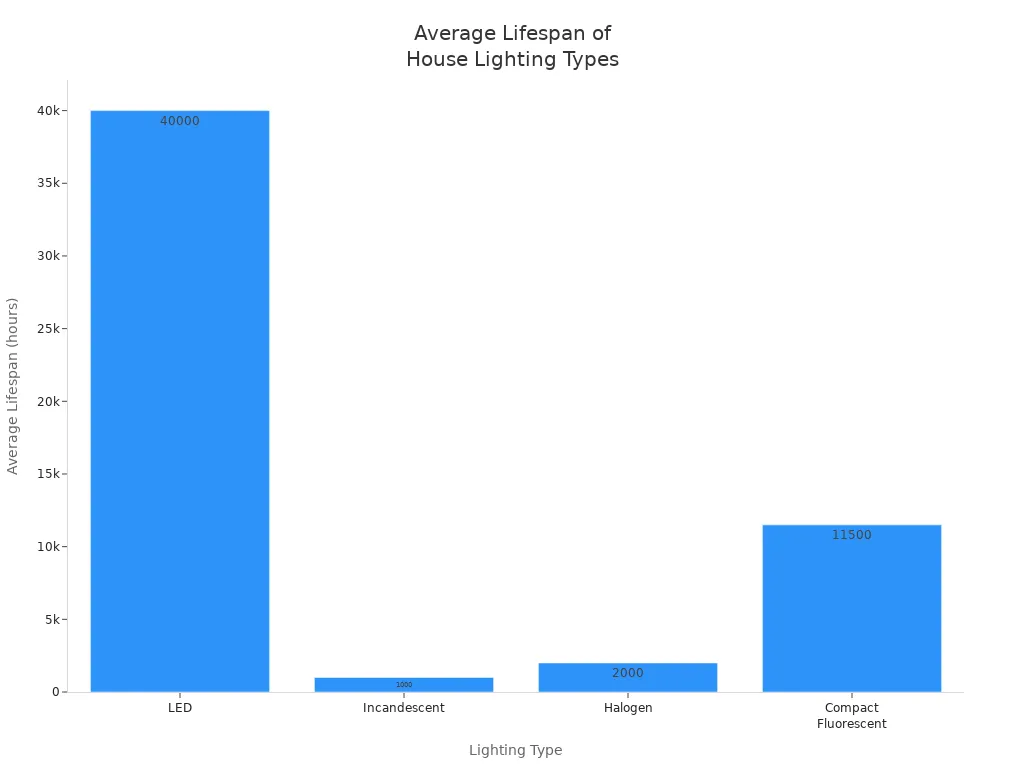
LED house lights last much longer than old bulbs. You can expect 20,000 to 60,000 hours from a good LED. That’s 25 to 50 times longer than incandescent bulbs and 10 to 30 times longer than CFLs. You save money and avoid the hassle of changing bulbs all the time.
Lighting Type | Average Lifespan (hours) | Comparison to LED Lifespan |
|---|---|---|
LED | 20,000 - 60,000 | 25 to 50 times longer than incandescent, 10 to 30 times longer than CFLs |
Incandescent | ~1,000 | - |
Halogen | ~2,000 | - |
Compact Fluorescent | 8,000 - 15,000 | - |
If you want lights that last, pick LEDs. You’ll spend less time changing bulbs and more time enjoying your home. 😊
Smart Features and Controls
Smart Bulbs
You can make your home smarter with smart led lights. These bulbs let you control your lighting in ways you never thought possible. You can set schedules so your lights turn on or off at certain times. Want a cozy movie night or a bright morning? You can create scenes that match your mood or activity. Smart led lights work with motion sensors, so lights come on when you walk into a room. This saves energy and makes life easier. You can even use voice assistants like Alexa or Google Assistant to control your lights with simple commands. Just say, “Turn on the kitchen lights,” and watch it happen.
Set schedules for automatic lighting
Create scenes for different activities
Use motion sensors for hands-free lighting
Control lights with your voice
Smart led lights help you save energy and make your home feel more comfortable.
App and Voice Control
You can control smart led lights from your phone or tablet. This means you don’t have to get up to adjust the lights. You can change brightness, turn lights on or off, or set timers with just a tap. Voice control lets you manage your lights while you cook, read, or relax. You can connect smart led lights to Alexa or Google Assistant for easy voice commands. This makes your daily routine smoother.
Wireless control and automation for convenience
Hands-free operation with voice commands
Adjust brightness to fit your needs
Program lights to turn off when not needed
Simulate occupancy to keep your home safe
Control lights remotely when you’re away
Smart led lights give you more control, save energy, and help protect your home. You get comfort, safety, and savings all in one package. 😊
Budget and Value
Upfront vs. Long-Term Cost
You might notice that LED house lights cost more at first. A single LED bulb can cost about $8, while a regular bulb might only cost $2. That sounds like a big difference, right? But when you look at the bigger picture, LEDs save you money over time. LEDs last much longer and use less energy. Check out this table to see how the costs add up:
Cost Factor | LED | Traditional |
|---|---|---|
Initial Cost | $8/bulb | $2/bulb |
Lifespan | 25,000 hrs | 1,200 hrs |
Annual Energy Cost | $1.50 | $7.50 |
10-Year Total | $23 | $92 |
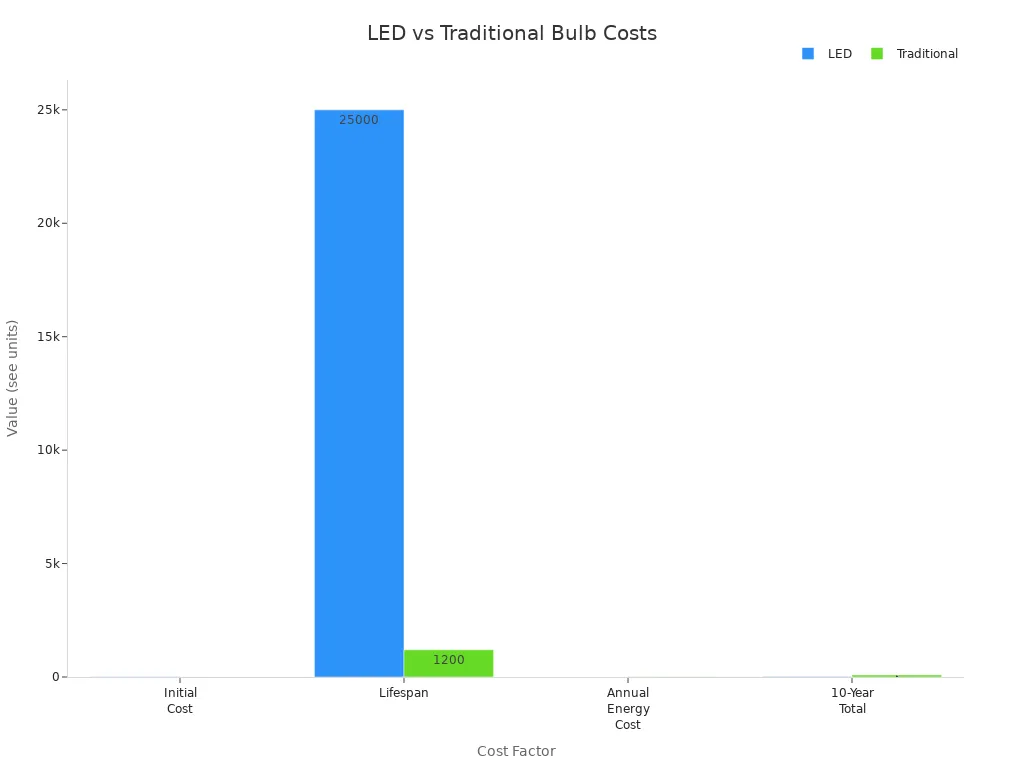
You can see that LEDs pay for themselves in just a couple of years. After that, you keep saving money every year. You also spend less time changing bulbs because LEDs last so long.
Value for Money
When you want the best value, you need to look at more than just the price tag. Here are some things you should think about:
Quality
Lifespan
Light output
Color accuracy
Potential rebates or incentives
Tip: Sometimes, you can get rebates or discounts for choosing energy-efficient lights. Always check with your local utility company!
If you pick LEDs with good quality and the right features, you get bright, reliable light and real savings. You make your home comfortable and keep more money in your pocket. 💡
You want each room to have the best lighting. Make sure you look at brightness and color temperature. Check if the lights work with your fixtures. Think about how much energy they use. Look for good quality and smart features. Don’t forget to think about the price. Use this checklist when you buy lights:
Lumen output
Color temperature
Dimming capabilities
Electrical specs
Installation
Maintenance
LEDs help you save energy. They last a long time and keep your home safe. 😊
FAQ
How do I know if an LED bulb will fit my fixture?
Check the bulb’s base type and size. Match it to your fixture. Most packages show this info. If you’re unsure, bring your old bulb to the store.
Can I use LED bulbs with a dimmer switch?
You can use dimmable LED bulbs with most modern dimmer switches. If your lights flicker or buzz, you may need a new dimmer made for LEDs.
Do LED house lights get hot?
LEDs stay cool to the touch. They use less energy, so they don’t heat up like old bulbs. You can handle them safely even after hours of use.
See Also
How to Select Ideal LED Lighting for Your Outdoors
Guidelines for Picking the Perfect LED Replacement Lights
Essential Factors to Evaluate for LED Street Light Installation