Lighting Tubes and Bulbs: Types, Technologies, and Applications

Lighting tubes and light bulbs help you light up places at home, work, and outside. There are different types like fluorescent lighting tubes, LED bulbs, incandescent bulbs, and halogen bulbs. The Asia-Pacific region is the leader in fluorescent lighting because it has many factories and lots of buyers. LED light bulbs are now popular all over the world. The market for LED bulbs is worth over USD 88 billion in 2024 and is growing quickly. Picking the right bulb changes how much light you get, how much energy you use, and how comfortable you feel. New LED lighting saves more energy, lasts longer, and costs less.
Here are some important facts:
LEDs save more energy and last longer than fluorescent bulbs.
Government rules push people to use better lighting.
Customizing lights makes them work better and feel nicer.
Key Findings | Description |
|---|---|
Adjustment Uncertainty | Lower light levels make lighting less certain. |
CCT Impact | People like color temperatures between 3500 K and 5500 K best. |
Customization Importance | Special lighting tubes and bulbs make rooms better and more comfortable. |
If you want to look at different products and pick the best light bulbs or tubes for you, this guide will help you choose wisely. Learn more about us and how we help you get the right lighting.
Key Takeaways
Pick LED bulbs to save energy and money. They last much longer than incandescent bulbs, up to 25 times more.
Check the brightness, which is measured in lumens. More lumens mean the bulb is brighter and lights up your room better.
Notice the color temperature, shown in Kelvin. Warm white bulbs make a room feel cozy. Cool white bulbs help you pay attention.
Choose ENERGY STAR certified bulbs for better energy use. These bulbs help lower your electric bill.
Smart lighting lets you change brightness and color with your phone. This makes it simple to set your lights how you like.
Types of Lighting Tubes and Bulbs
Picking the right light bulb type helps you get good lighting. There are many choices, from old bulbs to new tubes. Each kind has special features and works best in certain places.
Incandescent Light Bulbs
Incandescent light bulbs have been used for over 100 years. You see them in homes, stores, and lamps you can move. These bulbs make light when electricity heats a wire inside the glass. The glass keeps the wire safe with a vacuum or special gas. You can choose from many shapes, like the usual A-shape or fancy styles.
People use incandescent bulbs for:
Lighting homes
Lighting stores
Lamps and flashlights
Decorations and ads
Incandescent bulbs come in many sizes and voltages, from 1.5 to 300 volts. They give off a warm, soft light that feels familiar. But they do not save much energy. Less than 5% of the energy becomes light, so you pay more for power. You also need to change these bulbs often because they last only about 1,000 to 1,500 hours.
Did you know? If you use an incandescent bulb for 25,000 hours, you might spend about $169, but an LED costs only $30.
Bulb Type | Average Lifespan (hours) | Energy Efficiency (%) |
|---|---|---|
Incandescent | 1,000 - 1,500 | 10 |
CFL | 8,000 - 15,000 | 60 |
LED | > 25,000 | 80 |
Halogen Light Bulbs
Halogen light bulbs are a special kind of incandescent bulb. They use halogen gas to help the wire last longer and shine brighter. You get a bright, white light that looks nice for decorations.
Feature | Halogen Bulbs | Incandescent Bulbs |
|---|---|---|
Lifespan | About 2,500 hours | About 1,200 hours |
Energy Efficiency | Not very efficient | Not very efficient |
Maintenance Difficulty | Sensitive to oils, hard to keep clean | N/A |
Usage | Good for décor lights | N/A |
Halogen bulbs fit in track lights, ceiling lights, and accent lamps. You see them in fancy kitchens and stores. They also work in display cases, garden lights, and aquariums. These bulbs are sensitive to oils, so you must handle them with care.
Setting | Applications |
|---|---|
Residential | Track lights, ceiling lights, accent lamps, making rooms look nice, fancy kitchens. |
Commercial | Stores for product displays, warehouses for bright lights, factories. |
Specialty | Decorative lights, outdoor lights, aquarium lights, garden spotlights, display cases. |
Fluorescent Lighting Tubes
Fluorescent lighting tubes are long bulbs that use a special coating and gas to make light. You see these tubes in offices, schools, and stores. They use less power than incandescent bulbs, so you save money.
Feature/Benefit | Description |
|---|---|
Energy Efficiency | Uses less power than incandescent bulbs, so you pay less for electricity. |
Longevity | Lasts 7,000 to 15,000 hours, so you do not need to change them often. |
Cost-Effectiveness | Costs more at first, but you save money on bills and may get rebates. |
Versatility | Works in many places, like homes, businesses, and special uses. |
Environmental Impact | Makes less pollution and can be recycled, which helps the planet. |
Dimmable Options | Newer fluorescent lights can be dimmed, so you can change the brightness. |
Fluorescent tubes are good for places that need bright, even light. You can use them in garages, workshops, and big rooms. They last longer than incandescent bulbs and help lower your bills. But these tubes have mercury, so you must recycle them to keep the earth safe.
Lighting Type | Energy Efficiency | Environmental Impact |
|---|---|---|
Incandescent | Low | High (lots of waste) |
Fluorescent | Medium | Medium (mercury risk) |
LED | High | Low (no mercury) |
Compact Fluorescent Lamps (CFLs)
CFL bulbs are smaller versions of fluorescent tubes. You can screw them into regular light sockets, so they are easy to use at home. These bulbs have a built-in ballast, so you do not need a special fixture.
Feature | Compact Fluorescent Lamps (CFLs) | Traditional Fluorescent Tubes |
|---|---|---|
Size | Smaller, fits regular sockets | Bigger, needs special fixtures |
Ballast | Built-in ballast | Needs a separate ballast |
Lifespan | Lasts longer | Does not last as long |
Efficiency | Makes more light for less power | Not as efficient |
Application | Made for homes | Used mostly in businesses |
You can use CFL bulbs in chandeliers, wall lights, and table lamps. Offices and stores use them for general and task lighting. CFLs also work in street lights and exit signs. These bulbs help you save up to 75% on energy bills compared to incandescent bulbs.
Use Case | Description | Outcome Metrics |
|---|---|---|
Residential Lighting | CFLs replace incandescent bulbs in homes, used in chandeliers, wall lights, etc. | 60% of homes, 75% less energy, lower bills |
Commercial Lighting | Used in offices and stores for general and task lighting. | 30% less energy for stores |
Industrial Lighting | Good for storage rooms and workshops, often used with sensors. | 70% energy savings, less maintenance |
Street Lighting | Cities use them to save money. | 25% less energy in cities |
Emergency Lighting | Used in exit signs and backup lights for safety. | Meets safety rules, saves money |
LED Light Bulbs and Tubes
LED light bulbs and tubes use new technology to give you bright, efficient light. LEDs last much longer than other bulbs, sometimes up to 50,000 hours. You can find LED options that fit many fixtures and styles.
Advancement Type | Description |
|---|---|
Energy Efficiency | LEDs use much less power than old bulbs, so you pay less for electricity. |
Longer Lifespan | LEDs last much longer, so you do not need to change them often. |
Reduced Heat Emission | LEDs do not get very hot, so they are safer and save energy. |
Economic Viability | LEDs cost more at first, but you save money over time. |
Durability | LEDs are tough and do not break easily, so they work in many places. |
Design Versatility | Their small size lets you use them in many designs. |
Sustainability | LEDs are better for the planet and can be recycled. |
Improved Light Quality | LEDs give steady, clear light with good color. |
Adaptive Lighting Systems | LEDs can work with sensors to change brightness as needed. |
Human-Centric Lighting | LEDs can be set to help people feel better and sleep well. |
IoT Integration | LEDs can connect to smart systems for remote control. |
LiFi Technology | LEDs can send data using light, so they can do more than just light up a room. |
You use LED bulbs in homes, offices, and outside. LED fixtures work well in kitchens, bathrooms, and hallways. LED tubes can replace old fluorescent tubes in businesses. LEDs save up to 90% on energy and last up to 25 times longer than incandescent bulbs. You also get better light and less heat.
LED bulbs use less power to make the same light as old bulbs.
LEDs last up to 25 times longer than incandescent bulbs, so you change them less.
Longer life means you spend less on maintenance and make less trash.
Discharge Lamps
Discharge lamps use gases to make light. You find these bulbs in places that need strong, focused light. There are different kinds of discharge lamps:
Metal halide lamps: Used for lighting tall buildings, parking lots, shops, and sports fields.
High pressure sodium lamps: Often used for street lights and growing plants.
High pressure mercury-vapor lamps: Used in the past but now replaced by other types.
Discharge lamps are good for outdoor lights, sports fields, and big indoor spaces. They do not cost much at first but need more care over time. The light quality depends on the lamp type, and some need time to get bright.
Metric | Discharge Lamp | LED Lighting |
|---|---|---|
Source Life | 500 – 2,000 hours | 20,000 – 50,000 hours |
Power Consumption | Low to Medium | Low to Medium |
Color Mixing | Depends on color wheels | Very good, flexible |
Heat Output | Very hot | Not very hot |
Total Cost of Ownership (TCO) | Cheap at first, expensive later | Costs more at first, saves money later |
Control | Needs time to warm up | Turns on and off right away, easy to dim |
Tip: If you want lights that last long and save energy, you should pick LED bulbs or LED fixtures instead of old discharge lamps.
Now you know the main types of light bulbs and tubes. Each one has good points and works best in certain places. You can choose the right bulb or tube by thinking about energy use, how long it lasts, and where you want to use it.
Lighting Technologies Overview
Incandescent and Halogen Technology
Incandescent bulbs are common in homes. They make light when electricity heats a thin wire. The wire is made of tungsten. When it gets hot, it glows and gives off light. Halogen bulbs work almost the same way. They have a special gas inside. This gas helps the wire last longer and shine brighter. Both types give off a warm light that feels cozy. You can use them in lamps, ceiling lights, and for decoration.
Technology | Operation Description |
|---|---|
Incandescent | Works by sending electricity through a tungsten wire. The wire heats up and glows to make light. |
Halogen | Like incandescent, but has halogen gas to make it brighter and last longer. |
Fluorescent and CFL Technology
Fluorescent tubes and compact fluorescent lamps use a different way to make light. Electricity moves through a gas inside the tube. This makes ultraviolet light. The inside of the tube has a special coating. The coating changes ultraviolet light into visible light. These bulbs give bright, even light for offices, schools, and homes. CFLs are smaller and fit in regular sockets. Both types use less energy than old bulbs.
Technology | Operation Description |
|---|---|
Fluorescent | Uses a gas that makes ultraviolet light when powered. The coating inside the tube turns it into visible light. |
CFL | Works like fluorescent tubes but is smaller and has a built-in ballast. |
Light Emitting Diode (LED) Technology
LED lighting uses a tiny chip. When electricity goes through the chip, it makes light you can see. This way does not waste much energy. LED bulbs and tubes last much longer than other bulbs. You can use LEDs almost anywhere, like homes or stadiums. LED lights come in many colors and can work with smart controls. LED bulbs stay cool and help you save money over time.
Technology | Operation Description |
|---|---|
LED | Sends electricity through a chip to make light. This uses energy well and makes visible light. |
Discharge Lamp Technology
Discharge lamps use gases to make light. When you turn on the lamp, electricity moves through the gas. This makes a bright light. People use these lamps outside or in big rooms. Metal halide, high-pressure sodium, and mercury-vapor lamps are common types. These lamps need time to get very bright.
Pros and Cons of Each Technology
You should know what is good and bad about each lighting technology:
Category | Advantages | Disadvantages |
|---|---|---|
Incandescent | Warm light, cheap, easy to use | Does not last long, uses a lot of energy |
Halogen | Brighter than incandescent, better color | Gets very hot, not good at saving energy |
Fluorescent/CFL | Saves energy, lasts longer, good for big rooms | Has mercury, can flicker, needs to be recycled |
LED | Saves lots of energy, lasts long, stays cool, many colors, smart control | Costs more at first, can get dim if not cooled, may cause glare |
Discharge Lamps | Very bright, good for outside | Slow to start, big and heavy, has dangerous materials |
Tip: LED lighting is great because it saves energy and lasts a long time. You pay more at first, but you save money and energy later.
LEDs can last from 30,000 to 100,000 hours.
If LEDs get too hot, they can get dim faster.
Bright LEDs can cause glare, so good design is important.
You can pick the best lighting by thinking about where you need light, how much energy you want to save, and how long you want your bulbs to last.
Key Performance Metrics for Light Bulbs
Brightness (Lumens)
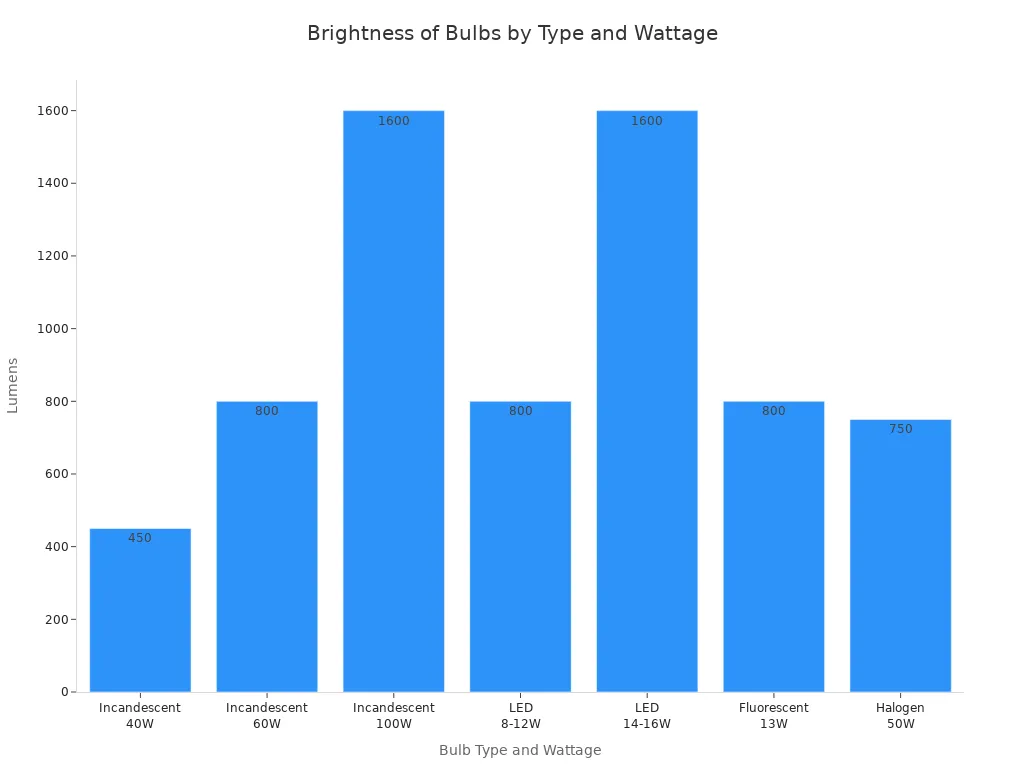
When you choose light bulbs, you need to look at brightness. You measure brightness in lumens. A higher number means a brighter light. You can compare bulbs by looking at how many lumens they give for each watt. For example, a 60W incandescent bulb gives about 800 lumens. An LED bulb uses only 8-12W to give the same brightness. You save energy and get the same amount of light.
Bulb Type | Wattage | Lumens |
|---|---|---|
Incandescent | 40W | 450 |
Incandescent | 60W | 800 |
Incandescent | 100W | 1600 |
LED | 8-12W | 800 |
LED | 14-16W | 1600 |
Fluorescent | 13W | 800 |
Halogen | 50W | 750 |
Color Temperature
Color temperature changes how a room feels. You measure it in Kelvin. Warm white bulbs (2500K - 3300K) make rooms feel cozy. Cool white bulbs (3500K - 4500K) help you stay alert. Daylight bulbs (5000K - 6500K) give strong, clear light. You can pick the right color temperature for your space.
Color Temperature | Kelvin Range | Effects on Ambiance |
|---|---|---|
Warm White | 2500K - 3300K | Relaxing, cozy atmosphere, good for living rooms and dining areas. |
Cool White | 3500K - 4500K | Stimulating, helps you focus, used in offices and warehouses. |
Daylight | 5000K - 6500K | Brightest, best for visibility, used in workspaces and places needing clear light. |
Tip: If you want a relaxing space, choose warm white bulbs. For work areas, cool white or daylight bulbs work best.
Energy Efficiency
Energy efficiency tells you how well a bulb turns power into light. LED bulbs give you more light for less power. You save money and help the planet. Look at the lumen per watt ratio to see which bulbs work best.
Lighting Type | Wattage | Lumen Output | Lumen per Watt |
|---|---|---|---|
Flame Tip, Candelabra LEDs | 3.5 | 25-35 | 7.14 - 10 |
LED Tube Lights | 8 | 120 | 15 |
LED Tube Lights | 16 | 240 | 15 |
Color Rendering Index (CRI)
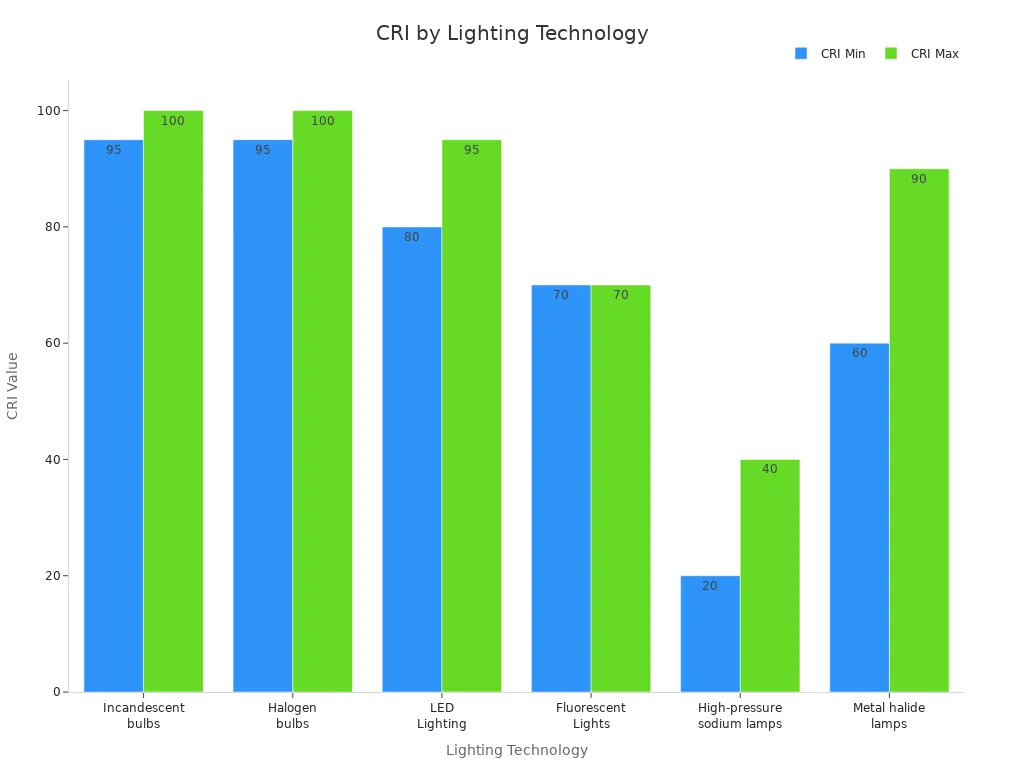
CRI shows how well a bulb shows colors. A higher CRI means colors look true. Incandescent and halogen bulbs have CRI near 100. LED bulbs have CRI from 80 to 95. Fluorescent bulbs have lower CRI, around 70. High-pressure sodium bulbs have very low CRI, so colors look dull.
Lighting Technology | CRI Range | Application Importance |
|---|---|---|
Incandescent bulbs | 95 to 100 | Best for showing true colors, good for art and design. |
Halogen bulbs | 95 to 100 | Good for places needing color accuracy. |
LED Lighting | 80 to 95 | Works for most uses, balances efficiency and color. |
Fluorescent Lights | ~70 | Not great for color, better for general lighting. |
High-pressure sodium lamps | 20 to 40 | Poor color, used outside where color is not important. |
Metal halide lamps | 60 to 90 | Used in big spaces, some color accuracy. |
Lifespan and Durability
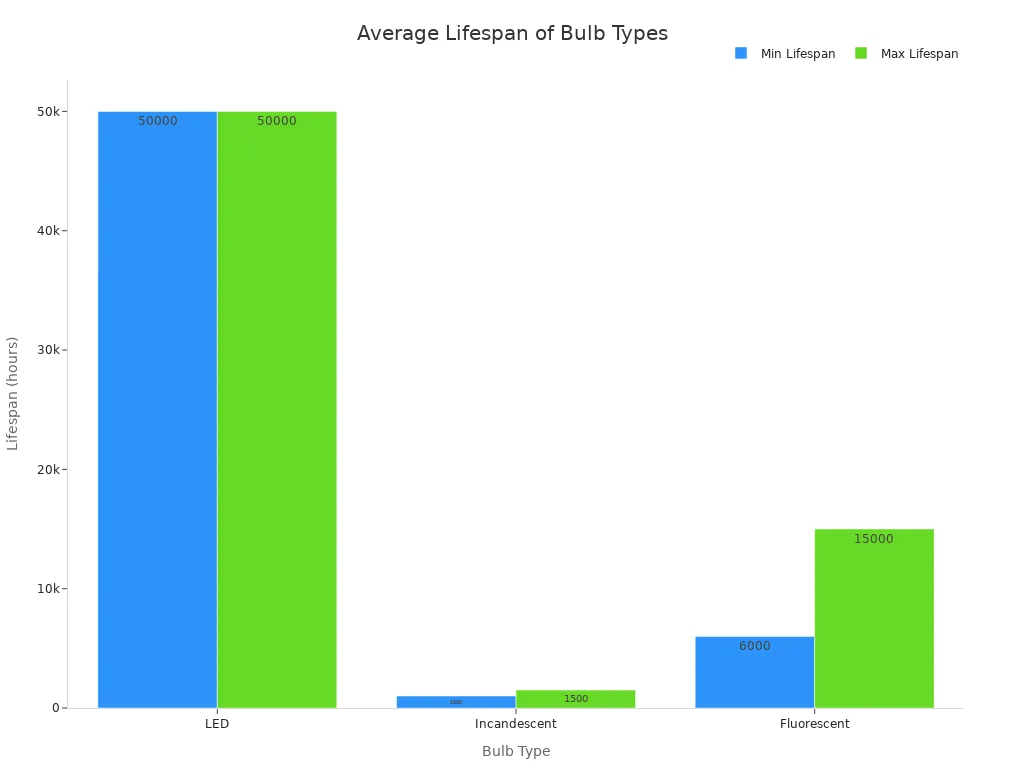
You want bulbs that last long and do not break easily. LED bulbs have the longest life. You can use them for up to 50,000 hours. Incandescent bulbs last only 1,000 to 1,500 hours. Fluorescent bulbs last 6,000 to 15,000 hours. LED life means you change bulbs less often and save money.
Bulb Type | Average Lifespan (hours) | Equivalent to Traditional Bulbs |
|---|---|---|
LED | Up to 50,000 | 25 traditional 60W incandescent |
Incandescent | 1,000 - 1,500 | 1 bulb |
Fluorescent | 6,000 - 15,000 | 4 - 15 bulbs |
Note: When you pick light bulbs, check the lifespan and durability. LED life gives you the best value and less hassle.
You can use these key metrics to compare light bulbs and find the best ones for your needs. Look at brightness, color temperature, efficiency, CRI, and lifespan. You will get better lighting and save money.
Applications of Lighting Tubes and Bulbs
Home Lighting
You use lighting tubes and bulbs at home every day. LED light bulbs are best for most homes. They save energy and last longer than old bulbs. You can pick RGB LED bulbs to change colors. Smart LED bulbs let you control lights with your phone. LED lights fit in recessed fixtures and let you change color temperature. Type A, B, and C LED tubes work in different fixtures. LED bulbs do not flicker much, so your eyes feel good. They also stay cool, which is safer for kids and pets.
LED bulbs help at home because:
You pay less for energy.
You change bulbs less often.
They are safer and do not get hot.
Material Type | Advantages | Limitations |
|---|---|---|
Metal | Strong, can be shaped, makes light brighter | Heavy, sometimes costs more |
Glass | Looks nice, gives soft light | Breaks easily, not used everywhere |
Plastic | Light, cheap | Not as strong, but new types last longer |
Commercial and Office Lighting
You see lighting tubes and bulbs in offices, stores, and schools. LED lighting gives bright, comfy light and saves money over time. Fluorescent tubes also work well in big rooms. Metal halide bulbs are very bright but need more care. Incandescent bulbs give warm light but use more power.
Lighting Technology | Advantages | Disadvantages |
|---|---|---|
LED | Saves energy, lasts long, feels nice | Costs more at first |
Incandescent | Warm light | Uses lots of energy, does not last, costs more to run |
Metal Halide | Very bright | Slow to get bright, gets hot, needs more care |
Fluorescent | Cheap, bright enough | Has mercury, can flicker, needs ballasts |
Industrial and Outdoor Lighting
You need strong, steady light in factories, warehouses, and outside. UFO high bay lights and linear high bay lights work in big rooms with tall ceilings. Vapor tight high bay lights keep out water and dust, so they work in tough places. Metal halide bulbs give bright, steady light in factories. LED tubes and bulbs save money and need less care, so they are best for factories.
Lighting Type | Description | Best Use Cases |
|---|---|---|
UFO High Bay Lights | Round lights for high ceilings, easy to put up. | Factories, warehouses, big stores, airplane hangars. |
Linear High Bay Lights | Long lights for wide rooms, can hang or mount. | Stores, warehouses, factories, places with rows or shelves. |
Vapor Tight High Bay Lights | Tough, sealed lights for wet or dusty places. | Outside, car washes, parking garages, kitchens, food plants. |
Metal Halide Bulbs | Bright, steady light, no wait to turn on, not dimmable. | Factories that need bright, steady light. |
Fluorescent Bulbs | Cheap, works okay, but uses more energy. | Factory aisles, when you want to spend less at first. |
LEDs | Saves energy, can dim, lasts long, costs more at first. | Factories that want to save money and do less work changing bulbs. |
Specialty and Decorative Uses
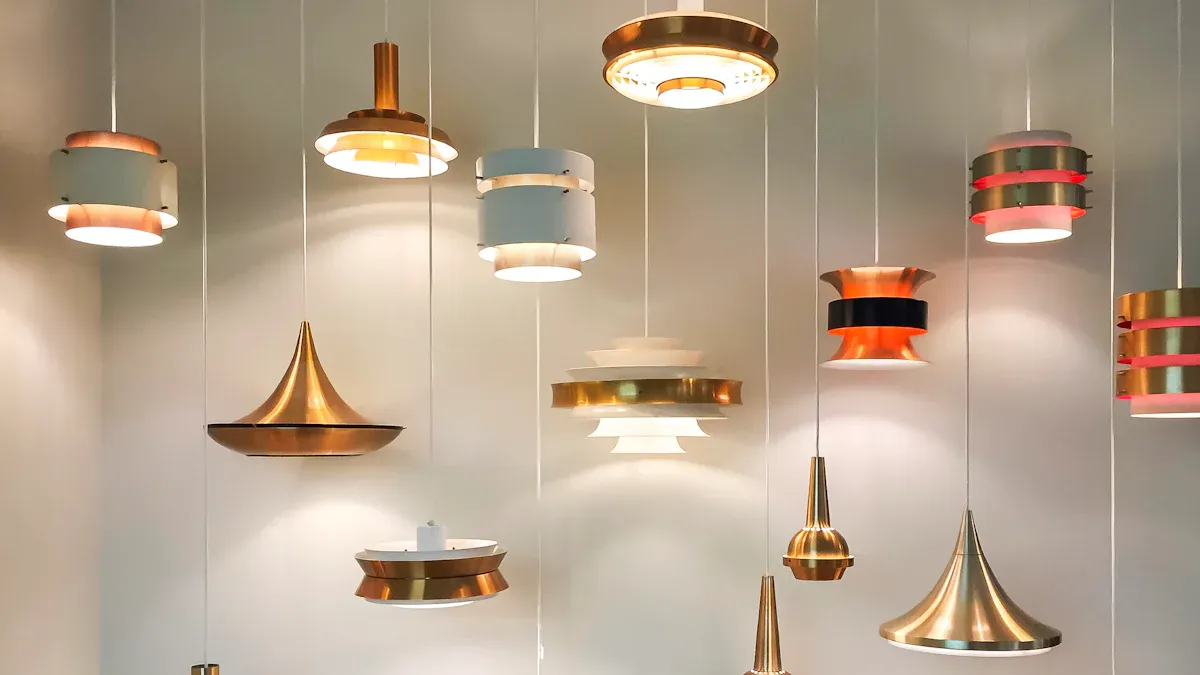
You can use bulbs and tubes to make special looks and moods. Decorative lights make rooms pretty and set the mood. You see these lights in chandeliers, hanging lights, and wall lights. LED bulbs let you pick colors for parties or holidays. Decorative bulbs make spaces feel romantic or fun.
Decorative lighting:
Makes rooms look better
Sets a certain mood or feeling
Fits in chandeliers and wall lights
Smart Lighting Applications
Smart LED tubes and bulbs change how you use lights. You can set times, change brightness, and pick colors with your phone or voice. Smart lights have sensors that turn on only when someone is there, so you save energy. Smart LED bulbs work with home systems for more comfort and control. You get easy use and save energy with smart lighting.
Smart lighting features:
Control from far away and set times
Turns on when people are there
Works with smart home systems
Lets you pick different light patterns
Tip: For the best lighting in any place, choose LED bulbs and tubes. They save energy, last long, and give you many choices for every need.
You have many lighting tubes and bulbs to choose from, such as incandescent, halogen, fluorescent, CFL, and LED. Each type works best in different places. When you pick lighting, think about what you need—brightness, color, energy use, and how long bulbs last.
Look for ENERGY STAR certified bulbs to save money and energy.
LED lights use less power, last longer, and need less maintenance.
Consider your space, how easy it is to install, and your budget.
New LED designs make it simple to upgrade and customize your lighting.
Smart choices help you light your space well and save money every year.
FAQ
What is the difference between lumens and watts?
Lumens measure how bright a bulb is. Watts show how much energy a bulb uses. You should look for lumens when you want more light and check watts to save energy.
Can you use LED bulbs in any fixture?
You can use LED bulbs in most fixtures. Make sure the bulb fits the socket and matches the voltage. Some old dimmers may not work well with LEDs.
How do you recycle old light bulbs?
Incandescent and halogen bulbs go in regular trash.
CFL and fluorescent tubes need special recycling because they have mercury.
Many stores offer recycling bins for these bulbs.
Why do some bulbs flicker?
Bulbs may flicker if the power supply is unstable or the bulb does not match the fixture. You should check the wiring and use bulbs made for your fixture.
Which bulb is best for reading?
Bulb Type | Color Temperature | CRI | Best For Reading |
|---|---|---|---|
LED | 4000K-5000K | 80+ | ✅ Yes |
CFL | 3500K-4500K | 80+ | ✅ Yes |
Incandescent | 2700K | 95+ | ❌ Too warm |
See Also
An In-Depth Overview of Street Light Bulbs and Their Uses
Essential Insights on Electric Lamps: Varieties and Their Uses
Understanding LED Light Bulbs: Advantages and Choosing Tips
Exploring Industrial LED Bulbs: Efficiency and Application Insights
Effective Commercial Lighting: Strategies and Best Practices for Businesses