How to Measure and Select LED Tubes for Fluorescent Lights in 2026

To measure LED tubes, you should start by looking at the length with pins. It's important to check the tube type, wattage, lumen rating, and base type. Measuring correctly helps you select the right LED tube for your home, ensuring that your lighting remains safe. Choosing the right product can prevent issues like flickering and poor lighting. Many people make mistakes by assuming that all tubes fit every fixture. They often overlook color temperature and fail to consider the layout of their lighting. By switching to LED, you can achieve better light quality and save energy. Experts recommend that you check these factors before making a purchase.
Common mistakes when picking LED tubes:
Assuming all tubes work with every fixture
Overlooking color temperature and CRI
Neglecting to check the lighting layout
For more information, you can visit our About Us page to learn more about our commitment to providing quality LED products.
Key Takeaways
Always measure your fluorescent tube’s length, including the pins. This helps make sure your new LED tube will fit right.
Check the tube’s diameter and type, like T5, T8, or T10. This helps you match it to your fixture and avoid problems.
Find out the base type of your old tube. This makes sure the new LED tube connects safely and works well.
Look at the lumen rating to see how bright the tube is, not just the wattage. LED tubes can give the same light but use less energy.
Read the manufacturer's information before you buy your new LED tube. This helps you check if it will work and what features it has.
Measure LED Tubes for Replacement
Measuring Length and Pins
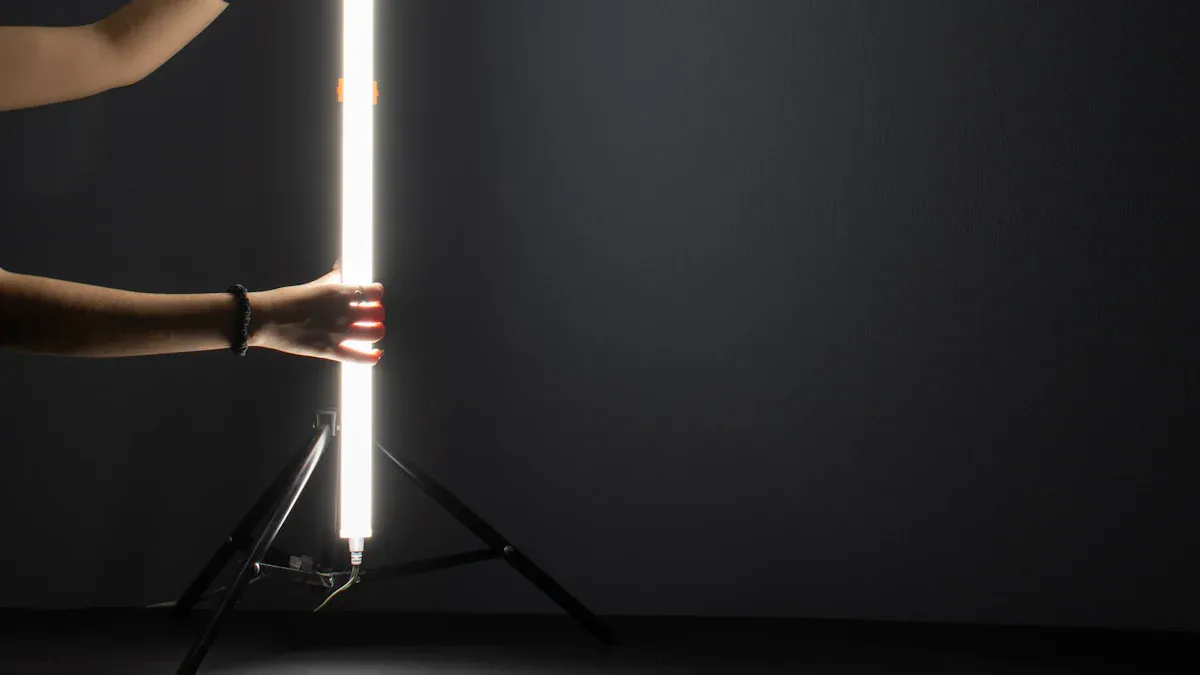
You must measure led tubes the right way. First, take the tube out of the fixture. Use a tape measure to check the length from end to end. Make sure you include the metal pins at both ends. The pins are part of the total length. They help the tube fit in your fixture. Hold the tape measure straight. Write down the measurement in millimeters or inches. This helps you match the new led tube to your old fluorescent tube. If you skip this step, the tube may not fit.
Tip: Always measure length with the pins included. This gives you the exact size you need for your fixture.
Tube Diameter and Type (T5, T8, T10)
After you measure the length, look at the tube’s diameter. Both tube size and length matter for fitting. Use a ruler or caliper to check the width at the thickest part. Most fluorescent tubes and led tubes come in standard sizes: T5, T8, and T10. The "T" means "tubular." The number tells you the diameter in eighths of an inch.
Here is a chart that shows common types, their lengths, and diameters:
Type | Lengths (mm) | Diameter (mm) | Diameter (inches) |
|---|---|---|---|
T5 | 549, 849, 1149, 1449 | 17 | 5/8 |
T8 Round | 588, 894, 1198, 1498 | 28 | 1 |
T8 Oval | 588, 894, 1198, 1498 | 30 | 1 |
T10 | N/A | 31.8 | 1.25 |
Always check if your fixture works with the tube size. Not all fixtures fit every tube type. Using the wrong size can cause bad lighting or damage. Some fixtures let you use more than one tube size. This gives you choices for upgrades later.
Base Type Identification
Base type is important when you measure led tubes for replacement. Look at the ends of your tube. Check the label for wattage and size. The base connects the tube to the fixture and gives it power. Picking the right base type makes sure your new led tube fits and works safely.
Make sure the base type matches your fixture to stop electrical problems.
Different led tubes need special sockets and ballasts. If you do not match these, you could have trouble installing.
Check if your fixture uses shunted or non-shunted sockets. This helps you avoid electrical shorts.
You can follow these steps:
Check the label on your old tube for wattage and size.
Find out what kind of ballast your fixture uses (magnetic, electronic, or none).
Choose which type of led tube you need (Plug & Play, Ballast Bypass, or Hybrid).
Note: Matching the base type and checking the fixture’s needs will help you avoid mistakes and make installation easy.
If you follow these steps, you can measure led tubes well and pick the right replacement for your fluorescent fixture. Always check your measurements and compare them to the product details before you buy new led tubes.
Compare LED Tubes and Fluorescent Tubes
LED Tube Types and Compatibility
When you look at led tubes and fluorescent tubes, you notice they work differently. There are three main led tube types: Type A (Plug-and-Play), Type B (Ballast Bypass), and Universal. Type A tubes go into your old fixture and use the same ballast. This makes putting them in quick and easy. Type B tubes need you to take out the ballast and wire the tube right to the power. This is called ballast bypass. Universal tubes can work both ways, so you can use them with or without a ballast.
LED Tube Type | Installation Method | Compatibility |
|---|---|---|
Type A | Plug-and-Play | Works with existing ballasts |
Type B | Ballast Bypass | Requires rewiring to bypass ballast |
Universal | Both methods | Compatible with Type A and Type B |
Tip: Pick Type A if you want to change your tube fast. Choose Type B if you want to stop ballast problems later. Always check your fixture before you buy a new tube.
Lumen Rating and Light Levels
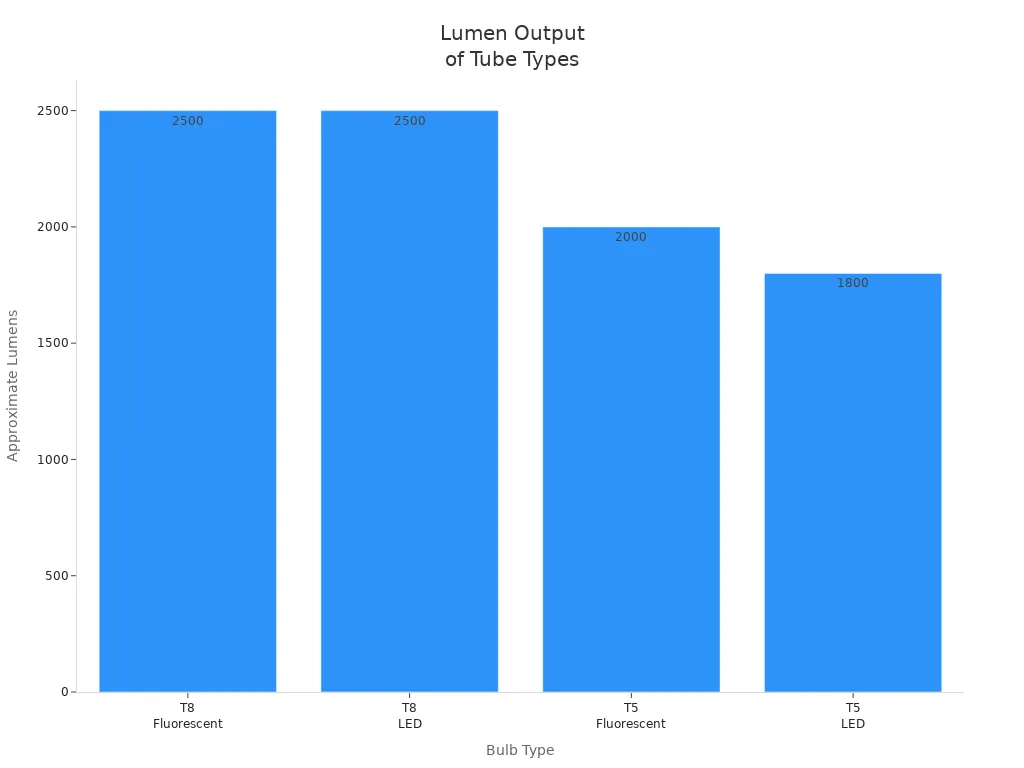
You should check led tubes by their lumen rating, not just wattage. Lumen rating shows how bright the light will be. Led tubes use less power but give the same or better light than fluorescent tube lights. For example, a t8 fluorescent tube uses 32 watts and gives about 2500 lumens. A t8 led tube only needs 18 watts for the same brightness. Some led tube high output models give even more light for big rooms.
Bulb Type | Typical Wattage | Approximate Lumens |
|---|---|---|
T8 Fluorescent | 32W | 2500 |
T8 LED | 18W | 2200-2500 |
T5 Fluorescent | 28W | 2000 |
T5 LED | 14W | 1600-1800 |
Installation Methods
There are a few ways to put led tubes in place of fluorescent tubes. Plug-and-play tubes let you keep your old ballast. This way is safe and simple. Ballast bypass tubes need you to take out the ballast and change the wires. An electrician should do this step. Hybrid tubes work with both ways, so you have more choices. Each way has good and bad points.
Installation Method | Pros | Cons |
|---|---|---|
Plug and Play (Type A) | Easy installation, no rewiring needed | Ballast may fail over time |
Ballast Bypass (Type B) | No ballast issues in the future | Requires minor rewiring |
Hybrid (Type A/B) | Flexible, can use both ballast and direct wire | Generally more expensive |
LED Retrofit Kits | Enhanced features, permanent solution | Higher upfront cost, more labor-intensive |
New LED Fixtures | Modern look, all benefits of LED | Larger investment required for materials and labor |
Note: Ballast bypass can be dangerous if you do not do it right. Always turn off the power and ask an expert for help. Plug-and-play tubes are safer for most people.
Led tubes save energy and last longer than fluorescent tubes. They use less power, give the same light, and fit many fixtures. When you plan to change your lights, always check the size, wattage, and how you will install the tube for the best results.
Select the Right LED Tube
Matching Measurements and Wattage
You should measure led tubes before you buy them. First, look at the socket type. T8 tubes use a G13 base. T5 tubes use a G5 base. This step helps you avoid mistakes. Next, match the new tube’s length to your old tube. Common sizes are 2 feet, 3 feet, and 4 feet. Always measure from end to end, including the pins.
Color temperature is important. Pick a tube with the same color temperature as your old one for the same look. When you choose wattage, find led tubes that give the same brightness but use less energy. This saves money and makes your lighting better.
Here is a simple guide for wattage:
Fluorescent Lamp Wattage | Recommended LED Tube Wattage |
|---|---|
20W Fluorescent | 10W LED Tube |
30W Fluorescent | 15W LED Tube |
40W Fluorescent | 20W LED Tube |
If you pick the wrong wattage, you can have problems. Too much wattage can make the tube too hot. Too little wattage can make your room too dark. Always check the maximum wattage for your fixture.
Tip: Match the size, base, and wattage. This helps you get led tube high efficiency and keeps your lights safe.
Ensuring Fixture Compatibility
Check if your fixture works with the led tube you want. Some led tubes fit right in. Others need you to change wires or remove the ballast. Type a tubes work with most electronic ballasts. Type b tubes need you to bypass the ballast and rewire. Universal tubes can do both.
Check these things for fixture compatibility:
Make sure your fixture fits the new tube size.
See if your fixture uses a ballast. If yes, check if the led tube works with it.
Decide if you want a direct replacement or need to retrofit.
If you need to bypass the ballast, ask an electrician for help.
Make sure the tube fits well and gives even light.
Think about how much light you need. Experts use footcandles to measure light levels. To find out how many lumens you need, follow these steps:
Find out what you do in the space. Reading needs more light than walking.
Measure the area in square feet.
Multiply the area by the footcandle level. For example, a kitchen of 1,000 square feet needs 40,000 to 50,000 lumens if you want 40-50 footcandles.
Pick led tubes that give enough total lumens for your space.
If you want led tube high output for big rooms, check the lumen rating on the package. This helps you get the right amount of light.
Buying Tips
When you shop for led fluorescent replacements, look for features that make installation easy. Here are some tips to help you pick the best product:
Pick led tubes that work with single and dual-end wiring. This gives you more ways to install.
Choose universal voltage tubes (120-277 VAC) for more flexibility.
Look for a G5 mini bi-pin base if you need a T5 tube.
Pick tubes with high brightness, like 3200 lumens, for big or bright spaces.
Make sure the tube is UL listed for safety.
Choose damp location rated tubes for kitchens, bathrooms, or garages.
Pick tubes with a shatter-resistant lens for extra strength.
Look for a long lifetime rating, like 50,000 hours, to reduce replacements.
Pick a color temperature of 4000K or 5000K for daylight-like light.
Check for a 5-year limited warranty for peace of mind.
Feature | Description |
|---|---|
Type A+B Compatibility | Works with most electronic ballast fixtures, no rewiring needed. |
Single or Dual-end | Increases compatibility with existing ballasts. |
Universal 120-277 VAC | Ensures functionality across different voltages. |
G5 mini bi-pin base | Usable with or without tombstones. |
High Brightness 3200LM | Provides excellent visibility for various settings. |
Fluorescent Replacement | Long-lasting LED tubes replace old fluorescent tubes. |
UL Listed | Tested for safety against fire risks. |
Damp Location Rated | Safe for use in moist places. |
50,000-Hour Lifetime Rating | Long lifespan for better lighting. |
5-Year Limited Warranty | Good warranty for customer support. |
Shatter-resistant lens | Strong and hard to break. |
4000K/5000K daylight color | Great for task lighting in many places. |
Always read the manufacturer’s specifications. These details tell you if the tube fits your fixture and meets your needs. Led tube high efficiency models use less energy and last longer. Energy-efficient leds do not have dangerous materials, so they are safer for your home or business.
Note: If you measure led tubes, check wattage, and confirm fixture compatibility, you will find the best led replacement tubes for your space. This helps you save energy, spend less money, and get good lighting.
You can make your fluorescent lights better by doing a few easy things. First, measure the tube’s length with the pins. Next, check how wide the tube is. Make sure the base matches your fixture. Look at lumen ratings to pick the right brightness. Always check if the tube fits your fixture before you buy it. Read what the manufacturer says to stop problems with your fluorescent fixture. There are two main ways to put in led tubes:
Method | Description |
|---|---|
Plug-and-Play | Goes into old fluorescent ballasts without trouble. |
Ballast Bypass | Needs new wiring for led tubes to work. |
Led tubes use less energy and make less trash. Check your measurements and needs again to make switching from fluorescent to led easy.
FAQ
How do you measure the length of a fluorescent tube for LED replacement?
You measure from one end of the tube to the other, including the metal pins. Use a tape measure. Write down the length in inches or millimeters. This helps you find the right LED tube size.
What does T5, T8, or T10 mean for LED tubes?
These codes show the tube diameter. T5 means 5/8 inch, T8 means 1 inch, and T10 means 1.25 inches. You match the tube type to your fixture for a proper fit.
Tip: Always check the tube label for type before buying.
Can you use LED tubes in any fluorescent fixture?
You need to check your fixture type. Some LED tubes work with ballasts. Others need you to remove the ballast. Universal tubes fit both ways. Always read the product instructions before installing.
What color temperature should you choose for LED tubes?
Pick a color temperature based on your space. Use 4000K for soft white light. Use 5000K for daylight brightness. You can check the package for color temperature information.
Color Temperature | Light Appearance |
|---|---|
4000K | Soft White |
5000K | Daylight |
See Also
Measuring LED Tubes: Choosing The Perfect Replacement Options
Accurately Measuring LED Tubes For Effective Replacement
Step-By-Step Instructions For Replacing Fluorescent With LED
Complete Guide To Switching From Fluorescent To LED Tubes
Top LED Replacements For Fluorescent Tubes In Business Environments