Exploring the Environmental Effects of Mercury Lamp Bulbs

You can face big dangers when you use mercury lamp bulbs. Mercury pollution from these bulbs hurts nature. In places like Longtang and Wenling, China, mercury in the soil is much too high:
Location | Mercury Concentration (μg/g) | Comparison to Standards |
|---|---|---|
Longtang, China | 10 times above permissible | Goes over safe levels for the environment |
Wenling, China | 1 to 31 times above Grade II | Goes over safe soil levels (0.3 μg/g) |
If a bulb breaks, mercury vapor gets out and can be even more harmful. The US Environmental Protection Agency says these bulbs are hazardous waste. You cannot throw them away with normal trash. You can pick LED lighting to use less mercury and keep yourself and nature safe. Go to our Home or About Us pages to learn more about our Product solutions.
Key Takeaways
Mercury lamp bulbs let out toxic mercury. This can hurt people and the environment.
LED bulbs are safer and use less energy. They do not have mercury inside.
Throwing away mercury bulbs the right way stops pollution. It also follows the rules.
Using LED lighting saves energy. It also lowers carbon emissions.
Recycling mercury bulbs keeps nature safe. It also helps keep the community safe.
Mercury Lamp Bulbs Overview
What Are Mercury Lamp Bulbs
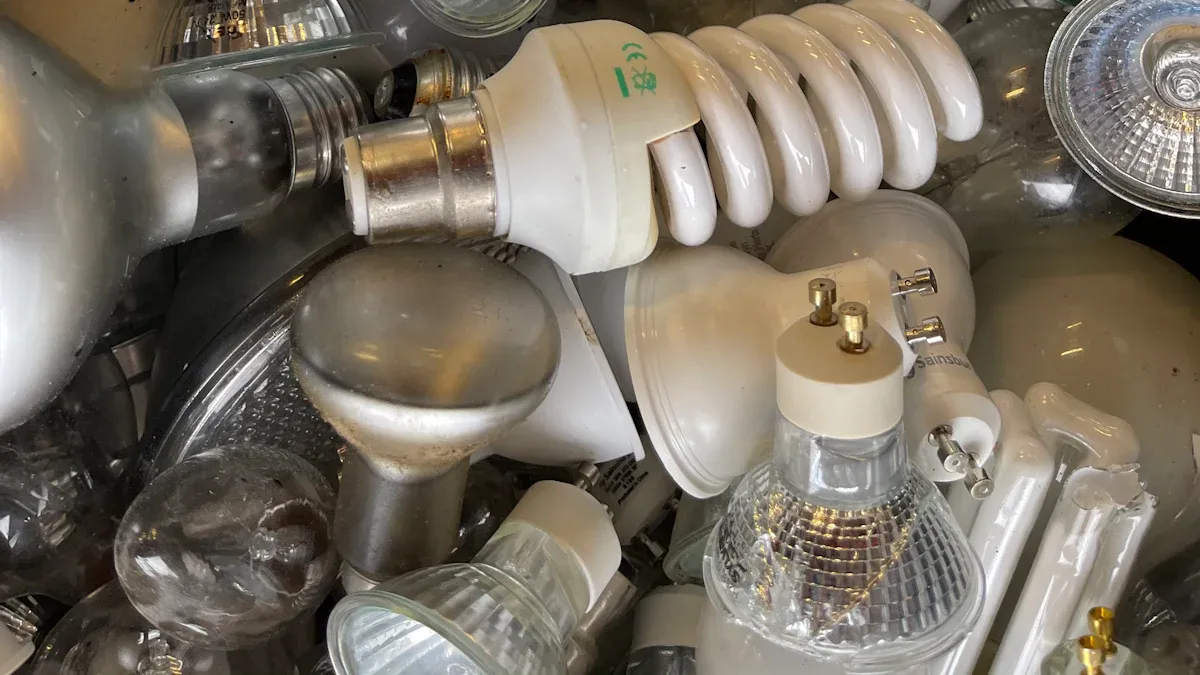
You might see mercury lamp bulbs in streetlights or big buildings. These bulbs are part of mercury vapor lamps. Mercury vapor lamps make light by using electricity. The electricity goes through a quartz arc tube. The tube has mercury and an inert gas inside. When you turn on the lamp, the electric current makes an arc. The arc heats up the mercury and turns it into vapor. This makes a bright bluish-white light.
A mercury vapor lamp has many parts. The quartz arc tube holds the mercury and gas. Main electrodes help start and keep the arc. A starting electrode helps the lamp begin working. The outer glass bulb protects the inside parts. It keeps the lamp safe. The base connects the lamp to power. All these parts work together. They help mercury vapor lamps last a long time.
Tip: Mercury vapor lamps can work for thousands of hours. But they have mercury inside, which is dangerous if it gets out.
Common Uses
Mercury vapor lamps are used in many places. They give strong and steady light. Cities use them for streetlights and parking lots. Factories and warehouses use them to light big areas. Mercury vapor lamps are important in projectors and cinema lighting. Their bright light helps show clear pictures on screens.
Scientists use mercury vapor lamps in labs. These lamps help with tests in chemistry tools. In microchip factories, mercury vapor lamps help make tiny parts. They shine light on special chemicals. Some companies use mercury vapor lamps for UV curing. UV curing helps dry inks and glue fast.
Projectors and cinema lighting
Scientific and laboratory instruments
Microlithography for microchip manufacturing
UV curing in manufacturing
Mercury lamp bulbs and mercury vapor lamps have many uses. But every mercury vapor lamp has mercury inside. So, it is very important to handle and throw them away safely.
Environmental Impact
Mercury Pollution
Mercury lamp bulbs can be dangerous to people and nature. Mercury vapor lamps let out mercury vapor while they work. New bulbs have elemental mercury inside. As bulbs get older, mercury mixes with phosphor and glass. This makes different types of mercury inside the bulb. Some mercury stays stuck in the glass. Other types can dissolve and leak out. If you break a bulb or throw it away wrong, mercury vapor can escape. This vapor is poisonous and can hurt your health and the environment.
Throwing away mercury vapor lamps adds more mercury to the earth. Most compact fluorescent lamps and mercury lamp bulbs end up in landfills. Almost all CFLs are not recycled. Mercury vapor from these bulbs can get into soil and water. The EPA found lots of mercury in groundwater near landfills. Mercury vapor lamp disposal can send mercury into rivers, lakes, and oceans. Mercury builds up in fish and shellfish. This can change what you eat.
Note: Mercury vapor lamps are hazardous waste. Never put them in regular trash. Landfills cannot take mercury lamps because they can harm water and the environment.
Disposal Risks
You need to be careful with mercury lamp bulbs. Throwing them away wrong can be risky. Mercury vapor lamps often break in dumpsters or trash cans. When a bulb breaks, mercury vapor goes into the air. Studies show broken CFLs can let out 200–800 μg/m3 of mercury vapor. This is much higher than the safe limit set by OSHA. In rooms with bad airflow, a new 13-W CFL can let out about 30% of its mercury in four days.
Getting rid of mercury vapor lamps can cause other problems too. Mercury can get into groundwater and make drinking water unsafe. Mercury vapor builds up in the food chain. It starts with plankton and moves to fish, birds, and people. Mercury lamp bulbs may also let out PCBs, which are bad for your health.
Health Risks | Ecological Risks |
|---|---|
Mercury is very poisonous to people, especially kids and babies. It can cause health problems that last a long time. | Mercury vapor lamp disposal puts mercury in landfills. This can pollute rivers, lakes, and oceans. Mercury builds up in fish and shellfish. |
The World Health Organization says mercury is a top chemical to worry about. | About 75% of fluorescent bulbs are not recycled. This makes pollution worse. |
Recycling mercury vapor lamps keeps mercury out of nature.
CFLs and other fluorescent bulbs often break when thrown away, letting out mercury vapor.
Mercury vapor lamp disposal can make hazardous waste that hurts people and animals.
Long-Term Effects
Mercury vapor lamps can harm the environment for a long time. Mercury vapor builds up in the food chain. It starts with plankton and goes up to big animals like eagles and seals. This causes health problems in wildlife. Birds can act strange, have fewer babies, and die more often. Fish numbers go down, which hurts the whole food web.
Mercury vapor lamp pollution stays in soil and water for years. It hurts many kinds of living things. Mercury vapor makes it hard for plants and animals to grow and survive. It changes how food webs work, soil health, and plant growth. Mercury lamp bulb pollution can cause less biodiversity and make ecosystems unstable.
Mercury vapor lamp pollution builds up in the food chain.
Wildlife gets sick and populations shrink.
Mercury vapor hurts soil, water, and plants.
Mercury lamp bulbs can harm the environment for decades.
Think about the environment before you pick mercury vapor lamps. Throwing away mercury vapor lamps makes hazardous waste and toxic mercury vapor. Mercury pollution from these bulbs can hurt your health, animals, and nature.
Efficiency Comparison
Mercury Lamp Bulbs Efficiency
Mercury vapor lamps do not use energy very well. They make less light for each watt of power. You only get 35 to 65 lumens per watt from these bulbs. They do not last as long as other bulbs. Mercury vapor lamp bulbs have mercury inside, which is bad for the environment. These bulbs waste energy because they turn a lot of it into heat. You will pay more for energy and new bulbs.
Lighting Technology | Lumens per Watt | Lifespan | Environmental Impact |
|---|---|---|---|
Mercury Vapor Lamps | 35 to 65 | Shorter lifespan | Contains hazardous materials |
LEDs | Over 100 | Longer lifespan | Environmentally friendly |
Mercury vapor lamp bulbs also cause more mercury pollution. Mercury vapor can get out when you use or throw away these bulbs. You will have higher energy bills and more risks to the environment with mercury vapor lamps.
LED Efficiency
LEDs use energy much better than mercury vapor lamps. You get over 100 lumens per watt with LED bulbs. LEDs last much longer than mercury vapor lamps. You save energy and money because LEDs use less power and need fewer replacements. Studies show that switching to LED lighting can save up to 80% energy compared to mercury vapor lamp bulbs. Both homes and businesses spend less money.
Study Title | Key Findings |
|---|---|
Mercury-Laced Fluorescent Bulbs Should Be Phased Out | Businesses get their money back in less than two months. Households get payback in about a year for common LED bulbs. |
2022 Technical & Economic Assessment of Mercury-Free Lighting | Switching to LED lighting saves a lot of money. Payback is often between 4 and 8 months for LED tubes. You save money right away when you buy general service lamps. |
LEDs do not have mercury inside. You do not have to worry about mercury vapor or disposal problems. LEDs help protect the environment and use less energy. You get more light, more savings, and lower costs with LED lighting. When you pick LEDs, you help save energy and make lighting safer for everyone.
Tip: You can lower your energy bills and help the earth by using LED bulbs instead of mercury vapor lamps.
LED Replacement Options
Benefits of LED
You can pick LED lights instead of mercury lamp bulbs. LED lights do not have mercury inside. This makes them safer for you and your workplace. Mercury vapor from broken bulbs can hurt your health. LED lights take away this danger. You get brighter light with LED lights. This helps you see better and lowers accident risks.
Aspect | LED Bulbs | Mercury Lamp Bulbs |
|---|---|---|
Illumination Quality | Gives brighter light | Dim light can cause accidents |
Accident Risk | Makes accidents less likely | More accidents from poor lighting |
Mercury Exposure | No mercury, safer for workers | Has mercury, which is dangerous |
LED lights last longer than mercury vapor lamps. You do not need to change bulbs often. This saves you time and money. LED replacement options use less energy. You get more light and save energy every month. Many states and utility companies give rebates for switching to LED lights. You can also find federal tax breaks and special programs for projects.
Type of Incentive | Description |
|---|---|
State-Specific LED Lighting Rebates | States give money to help you buy LED lights. |
Utility Company Incentives | Utility companies offer rebates for using energy-saving lights. |
Federal Tax Incentives | Businesses can get tax breaks for buying energy-saving lights. |
Custom Incentive Programs | Special programs help with unique lighting projects. Organizations like the Design Lights Consortium offer these. |
Tip: LED lights do not have mercury. You can recycle them easily and keep your area safe.
Environmental Advantages
LED lights help keep the environment clean. Mercury vapor from mercury lamp bulbs can pollute soil and water. LED lights do not let out mercury vapor. You lower the risk of hazardous waste in landfills. This makes recycling easier and safer. You do not need special recycling programs for LED lights. You can recycle them with other electronics.
Switching to LED lights cuts down carbon emissions. LED lights use less energy than mercury vapor lamps. You help fight climate change by saving electricity. LED lights also lower mercury vapor in nature. Mercury vapor can build up in fish and animals. You help keep nature healthy by picking LED replacement options.
The U.S. Department of Energy made new rules for energy efficiency. These rules help families save $1.6 billion every year. You waste less energy and help the earth. The Energy Independence and Security Act of 2007 also pushes for better energy use. This law makes it easier to choose LED lights over mercury lamp bulbs.
Note: LED lights do not have mercury. This lowers hazardous waste and keeps landfills cleaner.
Transitioning to LED
You can switch from mercury vapor lamps to LED lights in a few steps. Retrofitting mercury vapor lamps is easy if you follow safety rules. First, check your fixtures. See if your fixtures work with LED replacement options. You may need to retrofit or get new fixtures.
Check your fixtures. Decide if you need retrofitting or new ones.
Pick the right LED lights. Look at wattage, color, and beam angle.
Put in the LED lights. Follow safety steps and use the right tools.
Test your new lights. Make sure they work well and meet standards.
Retrofitting may mean bypassing HID ballasts for better LED use. You must turn off power before you start. Use the right wires and connectors. Insulate and secure all connections. Pick LED tubes marked 'ballast bypass' or 'direct wire'. Check the socket type and voltage ratings. Get tools like wire cutters, strippers, and electrical tape. Turn off power at the breaker box and check with a multimeter. Remove the ballast and connect power wires to the LED tube. Make sure all connections are safe and covered.
Tip: Always check local electrical codes before retrofitting. This keeps you safe and avoids trouble.
COB bulbs are a good choice for LED replacement options. COB means "chip on board". These bulbs give strong, even light. You get better energy use and lower costs. COB bulbs work well when you bypass HID ballasts.
You can recycle LED lights more easily than mercury vapor lamps. Mercury vapor lamp disposal needs special recycling programs. LED lights do not need these programs. You help the environment by recycling LED lights. You also lower the risk of mercury vapor pollution.
Reminder: LED lights are good for the environment. You get safer disposal, better recycling, and less mercury vapor in nature.
Regulations
Mercury Lamp Bulbs Laws
It is important to know the rules for mercury lamp bulbs. Many countries have strong laws about mercury vapor and how to throw away these bulbs. These laws keep people and nature safe from mercury vapor pollution. There are worldwide rules that control how you use and get rid of mercury vapor lamps. The Minamata Convention on Mercury sets limits for mercury vapor in lamps. It also controls how much mercury can be in compact fluorescent lamps, linear fluorescent lamps, and high pressure mercury vapor lamps. After 2020, you cannot make, bring in, or send out lamps with too much mercury vapor.
Here is a table with some key international rules:
Regulation | Description |
|---|---|
Mercury Regulation (EU) 2017/852 | Stops making, sending out, and bringing in some lamp types after 31.12.2020. |
Minamata Convention on Mercury | Controls making, bringing in, or sending out mercury-added lamps with set mercury limits after 2020. |
Directive 2012/19/EU (WEEE) | Makes sure waste electrical and electronic equipment is collected and recycled separately. |
Directive 2011/65/EC (RoHS) | Bans dangerous chemicals, like mercury, in new equipment sold after 1 July 2006. |
There are also rules in each country to stop using mercury vapor lamps and other bulbs. States like California, Colorado, and Hawaii have set dates to stop using some bulbs. These rules help people use safer lights like led lights. States want less mercury vapor pollution and to save more energy.
State | Phase-Out Date | Type of Bulb Banned | Additional Notes |
|---|---|---|---|
California | By 2025 | All main types of fluorescent bulbs | Tries to use less energy and help the environment. |
Colorado | By 2025 | CFLs and linear fluorescent bulbs | Focuses on high-CRI fluorescents since 2021 to cut mercury waste. |
Hawaii | 2021 & 2025 | High-CRI fluorescents and all CFLs | Part of a bigger plan to fix mercury problems and use energy better. |
Maine | By 2026 | Some fluorescent lights | Wants people to use greener technology. |
Maryland | 2024 & 2025 | High-CRI fluorescents and others | Tries to follow federal energy rules and help the environment. |
New Jersey | 2023 | High-CRI fluorescent lamps | Has tougher rules to protect the environment. |
Oregon | 2023 & 2024 | High-CRI fluorescents, CFLs, linear | Has clear dates to stop using certain bulbs. |
Compliance Issues
You have to follow the rules for throwing away mercury vapor lamps. If you do not, you can get into trouble. The law says you cannot put mercury lamp bulbs in normal trash. You must take them to special recycling centers. Mercury vapor from broken bulbs can get into the air, dirt, and water. You help stop mercury vapor from hurting nature when you follow the rules.
If you throw away fluorescent lamps and bulbs the wrong way, it is against the law. You can get big fines or even go to court. You may also have to pay for cleaning up pollution.
You should check your local rules before you throw away mercury vapor lamps. Some places have extra steps for mercury content and disposal. More rules are coming as states try to stop mercury vapor pollution and save energy. You can use led lights to avoid mercury vapor problems. Led lights do not have mercury vapor, so you do not need special disposal.
When you follow the rules for mercury vapor lamps, you help the earth. You keep mercury vapor out of landfills and water. You also save energy and cut down on pollution. You make your community safer by using led lights and recycling mercury lamp bulbs the right way.
You can get hurt if you use mercury lamp bulbs. Mercury vapor lamps let out mercury, which is very poisonous. This can make you sick and harm the earth. If a mercury vapor lamp breaks, you might breathe in dangerous mercury. It is worse if you do not throw it away the right way. Using LED bulbs saves energy and money. LEDs also help keep nature safe. LED bulbs last longer and have no mercury inside. When you recycle mercury lamp bulbs and pick LED bulbs, you help stop mercury pollution and lower carbon emissions.
Remember: Throwing away mercury lamp bulbs the right way and using LED bulbs helps keep your community and the earth safe.
Mercury is very poisonous and can hurt your health.
LED bulbs use less energy and save money.
Recycling mercury lamp bulbs stops pollution.
LED bulbs help lower mercury and carbon emissions.
FAQ
What should you do if a mercury lamp bulb breaks?
Open windows and leave the room for 15 minutes. Wear gloves and use sticky tape to pick up pieces. Place all waste in a sealed container. Take it to a hazardous waste center.
Why are mercury lamp bulbs dangerous for the environment?
Mercury lamp bulbs release toxic mercury. Mercury pollutes soil and water. Fish and animals can get sick. You help protect nature when you recycle these bulbs.
Can you put mercury lamp bulbs in regular trash?
Disposal Method | Safe? |
|---|---|
Regular Trash | ❌ No |
Hazardous Waste Site | ✅ Yes |
You must take mercury lamp bulbs to a hazardous waste center. Never put them in regular trash.
How do LED bulbs help the environment?
LED bulbs do not contain mercury. You use less energy and create less waste. LED bulbs last longer. You help lower pollution and save money.
Are there laws about mercury lamp bulbs?
Many states and countries have laws. You must recycle mercury lamp bulbs. You can get fines if you throw them away wrong. Always check local rules before disposal.
See Also
Comparing Low Pressure Sodium And LED Lights: Efficiency And Impact
LED Lamps Compared To Conventional Lighting Solutions
Understanding Street Light Brightness And Its Community Effects
Effective Commercial Lighting Strategies For Business Environments