Street Pole Light Configurations

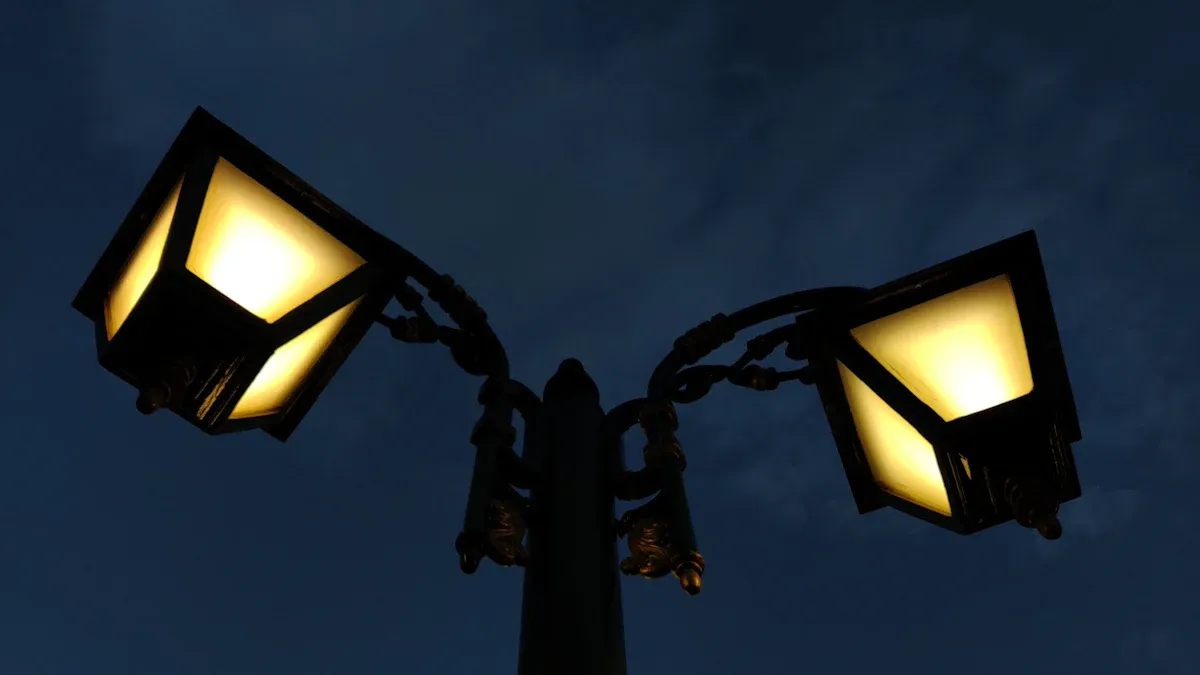
Street pole light configurations change how you feel safe at night. They help you feel comfortable on city streets. You see brighter Led Light with new setups. The light looks even and helps people stay safe.
Home and About Us sections talk about Product features. These features use less energy and save money.
Good lighting does not mean more light. Studies show that using just enough light keeps you safe. It also saves energy and does not waste it.
Key Takeaways
Street pole light configurations help people see better at night. They make cities feel safer for everyone.
LED lights use less energy and cost less to keep working. They give brighter light and have fewer dark areas.
The right pole height and spacing are very important. You should follow local rules for safety and good lighting.
Street Pole Light Configurations Overview
Definition and Purpose
When you walk at night, street lights help you feel safe. Street pole light configurations decide how cities use light poles. These setups keep roads and sidewalks bright. The way poles are placed changes by street type. Quiet neighborhoods have different poles than busy highways. Most poles are between 30 and 50 feet tall. Smaller places use shorter poles. If a street is wider than 65 feet, poles go on both sides. Medium streets have poles in a zigzag pattern. On narrow streets, all the poles are on one side.
Cities care about these setups for many reasons. Look at the table below to see why:
Purpose | Description |
|---|---|
Enhancing safety and security | Good lighting helps people feel safe after dark. |
Improving visibility for pedestrians | Bright sidewalks help stop accidents and help you see better. |
Deterring crime | Well-lit areas make people feel safe and can stop crime. |
Contributing to urban aesthetics | Smart lighting makes places look nice and shows off cool buildings. |
Promoting energy efficiency | New systems save energy and money while keeping people safe. |
Street lighting does more than light up roads. It helps you feel safe and lets you see well. It also makes your city look nicer. Cities want to save energy, so they use smart designs and new technology.
Key Components
If you look at a light pole, you will see many parts. Each part helps the street pole light configurations work well. Here are some common parts:
Types of light poles: Some use anchors, others are buried in the ground.
Hand hole cover: Workers use this to fix wires and do repairs.
Pole cap: This goes on top, especially for side-mounted lights.
Anchor bolts: These hold the pole steady. Big poles need strong bolts.
Vibration dampener: This stops shaking, which helps if cameras are attached.
Side brackets: These hold extra lights for more coverage.
Electrical outlets: Sometimes poles have outlets for decorations or events.
Banner brackets: Cities use these to hang signs or banners.
Light pole tenon: This is where the light or bracket attaches.
Cities do not just put up any pole lights. They need to plan and design carefully. They check the site and talk to the community. Everything must fit together. Regular maintenance keeps lights working and safe. Workers follow safety rules so poles do not fall or break.
Technology keeps changing street pole light configurations. New materials last longer and look better. Some poles change brightness or color during the day. Smart city systems let poles talk to other city equipment. Cities use artistic lighting for unique styles.
In the future, you will see more smart technology in street lighting. Poles may help with 5G networks or charge electric cars. Some will connect with traffic systems to help things run smoothly. The International Energy Agency says smart street lighting can cut energy use by half. This saves money and helps the environment.
Configuration Types
Mounting Arrangements
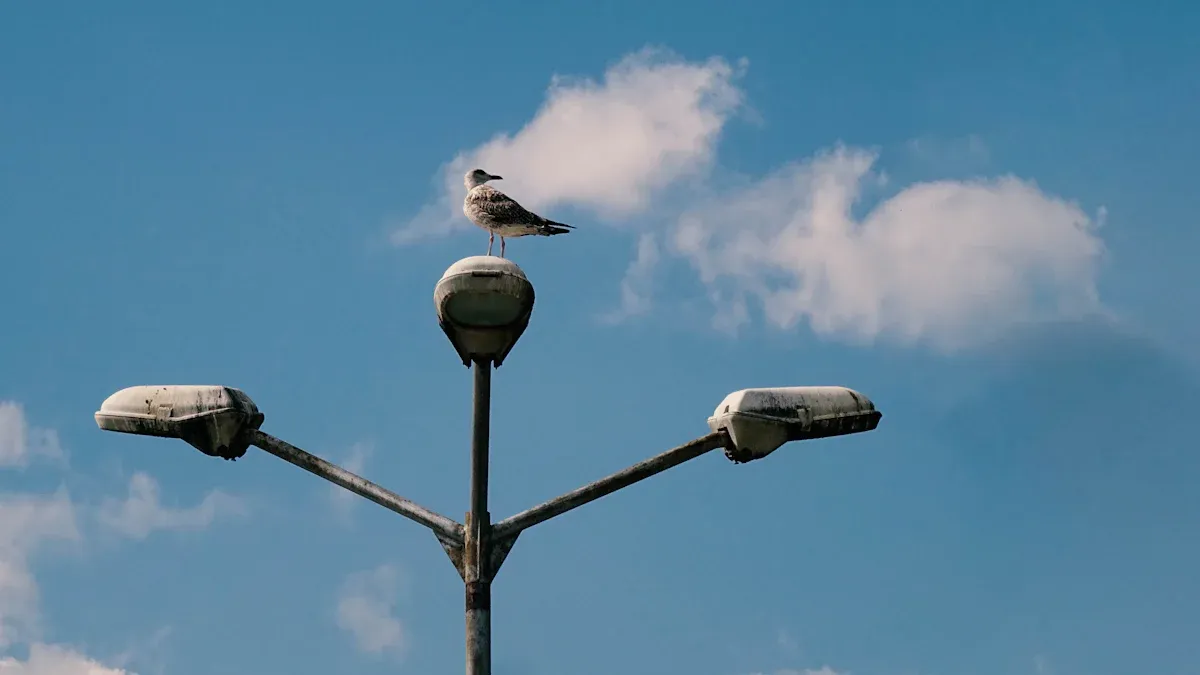
You can see that light poles are set up in different ways. The way these poles are placed changes how well the street is lit. Here are some common mounting arrangements:
Single-sided: All the light poles are on one side of the street. This is best for small roads or quiet places.
Staggered: Light poles switch sides in a zig-zag pattern. This spreads the light out and helps you see better on bigger roads. Staggered poles also make fewer shadows and help keep people safe.
Opposite: Light poles stand right across from each other on both sides. This gives strong and even lighting for busy streets.
Central: Light poles are in the middle of the road or on a median. You see this a lot on highways or big streets.
Picking the right setup can make streets safer and use less energy.
Pole Types and Materials
There are many kinds of light poles in cities. Each kind uses different materials and shapes. Here is a quick look:
Type of Pole | Material | Advantages |
|---|---|---|
Octagonal | Steel | Very strong, lasts a long time, easy to put in, looks modern |
Davit | Aluminum | Not heavy, does not rust, easy to take care of, simple to recycle |
Galvanized | Steel | Very tough, handles bad weather, works in many places |
Concrete | Concrete | Very steady, but heavy and hard to move |
Fiberglass | Fiberglass | Light, does not rust, but can break and costs more to fix |
You see these poles in parks, parking lots, and along streets. The right material helps your street pole light configurations last longer and work better.
Lighting Symmetry
Lighting symmetry is about how light spreads on the street. You want the light to be even with no dark spots. Look at this table:
Lighting Type | Effect on Uniformity | Energy Consumption |
|---|---|---|
Asymmetric Lighting | Lights up certain spots, less glare | Uses less energy |
Symmetric Lighting | Spreads light everywhere | Might use more energy |
Good symmetry in street lighting keeps people safe and helps them see well. It also stops hard shadows and makes the street look nice.
Key Factors in Street Pole Light Configurations
Pole Height Standards
When you look at light poles on different streets, you might notice they come in many heights. Picking the proper height matters for safety and how well you can see at night. The right light pole height depends on where you use them. Here’s a quick guide:
Application Area | Recommended Pole Height |
|---|---|
Residential Streets | 15 to 20 feet |
Wider Roadways | 25 to 50 feet |
Parks (Pathways) | Shorter poles |
Parks (Sports Fields) | Taller poles |
Commercial Areas | Varies (shorter for walkways, taller for parking lots) |
Urban Environments | Must accommodate utility lines |
General Guidelines | Consult local regulations |
You should always check local rules before you install new light poles. Using the proper height helps you avoid dark spots and keeps everyone safe.
Spacing Guidelines
The distance between light poles changes how bright and even the street looks. If you space them too far apart, you get dark patches. If you put them too close, you waste energy. Here’s a table to help you decide:
Pole Height | Recommended Spacing (ft) |
|---|---|
20 ft | 50 to 70 |
25 ft | 62 to 87 |
30 ft | 75 to 105 |
Most experts say you should space light poles about 2.5 to 3.5 times the light pole height. You also need to think about speed limits, road type, and things like trees or buildings that block light.
Luminaire Arms and Positioning
The way you set up luminaire arms on pole lights changes how the light spreads. Here are some tips:
Keep the arm overhang less than one-quarter of the installation height for good coverage.
Use a boom tilt angle under 15 degrees to avoid glare and keep light even.
Place light poles closer together for better uniformity, but remember this can cost more.
If you follow these tips, your street pole light configurations will give you safer and brighter streets.
LED and Solar Options
LED Luminaires
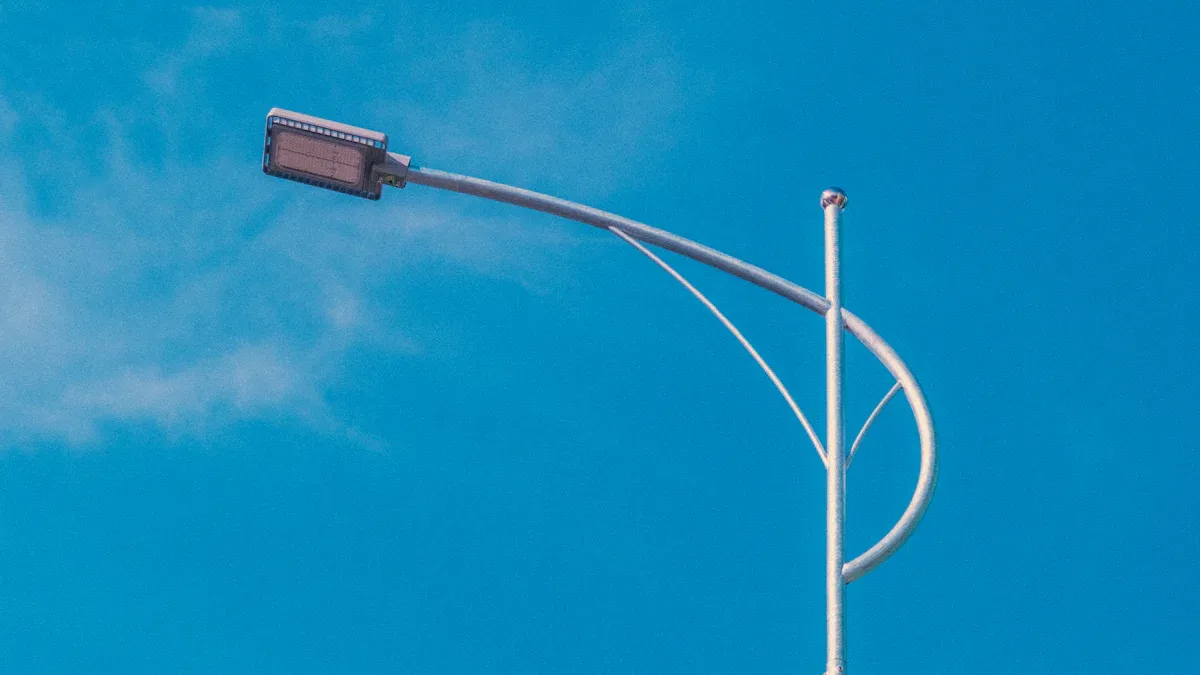
Many cities now use led for street lights. Led makes roads and sidewalks bright and clear. Led on poles gives better light and fewer dark spots. Led helps save energy and money. You need fewer poles because led spreads light well.
Look at this table to see how led and old lights are different:
Feature | LED Street Lights | Traditional Street Lights |
|---|---|---|
Energy Efficiency | Uses much less power | Needs more power |
Light Quality | More even lighting | Lighting is less even |
Area Coverage | Fewer lights needed | Needs more lights |
Led lasts longer than old bulbs. You do not change led as much, so you save time and money. See these numbers:
Feature | LED Luminaires | Traditional Lighting |
|---|---|---|
Energy Consumption | 50-80% less energy | Uses more energy |
Lifespan | 50,000 to 100,000 hours | 10,000 to 24,000 hours |
Maintenance Frequency | Not needed often | Needed more often |
Cost Efficiency | Lower maintenance cost | Higher maintenance cost |
Led on poles means less work and lower bills. Led uses less power. For example, a led street light might use 30 to 50 watts. An old HPS lamp uses 100 watts. This can cut energy costs by half.
Solar Lighting Solutions
You may see solar lights on poles in parks and trails. Solar uses sunlight to power lights, so you do not pay for electricity. You do not need wires or digging, so putting up solar lights is easier.
Here is a table that shows how solar and regular lights compare:
Aspect | Solar Street Lights | Traditional Street Lights |
|---|---|---|
Installation Cost | Saves up to 40% | Costs more (needs digging) |
Ongoing Energy Expenses | $0 | $1,200 over 5 years |
Maintenance Cost | $50/year | $120+/year |
Energy Costs | $0 | $20/month |
Solar on poles means you spend less to set up and almost nothing for energy. You do not have to dig up roads for wires. Maintenance is easy. You just check the solar panels and batteries sometimes. If you want to help the planet and save money, solar on poles is a good idea.
Application Considerations
Residential Streets
When you walk at night in your neighborhood, you want to feel safe. Short light poles are close together. This helps keep sidewalks bright and stops dark spots. Cities use led so lights turn on and off right away. You do not have to wait for lights to warm up. Directional lighting shines light where you need it most. This helps lower light pollution. Led gives good color, so you can see people and things clearly. Dimmable led lets cities use less energy when they do not need much light.
Feature | Description |
|---|---|
Instant On/Off | Lights turn on fast for safety |
Directional Lighting | Shines light where needed, lowers pollution |
Color Rendering | Makes it easy to see people and objects |
Dimmability | Changes brightness to save energy |
Highways and Major Roads
On highways and big roads, light poles are much taller. These poles are between 25 and 50 feet high. Led lights cover wide areas and help drivers see well. Arm-mounted and post-top setups spread light evenly. Wide roads need poles on both sides or in the middle. Cars move fast, so poles are spaced farther apart. Led helps drivers see better and react quickly.
Street Type | Light Pole Height |
|---|---|
Residential Streets | 15 to 20 feet |
Major Roads | 25 to 50 feet |
Arm-mounted setups
Post-top setups
Parks and Public Spaces
In parks, light poles are set up for different areas. Led lights make paths safe and show playgrounds clearly. Cities use solar power for poles in faraway places. Dark Sky-compliant fixtures help protect animals by lowering light pollution. Smart controls let cities change led brightness when park use changes.
Consideration | Description |
|---|---|
Create distinct lighting zones | Different lights for different activities |
Prioritize safety and visibility | Lights up dangers and helps stop crime |
Opt for Dark Sky-compliant fixtures | Lowers light pollution |
Incorporate smart lighting controls | Changes brightness when park activity changes |
Commercial Areas
When you go to shopping centers, you see lots of light poles. Led keeps parking lots and walkways bright. The space between poles depends on how big the area is and how busy it gets. Taller poles light up bigger spaces. Shorter poles work for walkways. Solar is used a lot in outdoor malls and plazas. Good spacing stops dark spots and saves energy.
Tip: Use led and solar to save money and stay safe everywhere.
Standards and Safety
Regulatory Codes
You might wonder who decides how light poles get installed in your city. Many rules and standards guide these choices. These codes make sure your streets stay safe, bright, and friendly for everyone. Take a look at this table to see some important standards:
Standard/Regulation | Description |
|---|---|
ISO 9001 | Sets rules for quality in making light poles and lighting systems. |
EN 60598-2-3 | Lists what street lighting must do, including safety for junction boxes. |
ANSI C136.37 | Covers equipment for roadway and area lighting, like electrical parts. |
IDA Standards | Helps reduce light pollution and guides how to design lighting. |
RoHS Directive | Limits dangerous materials in lighting equipment. |
Cities also have their own rules. Some places limit how bright light poles can be. Others ask for public input before new lights go up. You may see cities require checks to protect wildlife and save energy.
Safety Requirements
You want light poles that work well and last a long time. Safety rules help make that happen. Here are some key requirements:
Light poles must handle hot and cold weather.
All wiring must be safe for outdoor use.
Poles need to keep out dust and water (IP66 rating).
The material must not rust or break easily.
Poles must pass tests for strong impacts.
All parts must follow rules that keep out harmful chemicals.
Check out this table for more details:
Requirement | Description |
|---|---|
Operating Temperature | Works from -35°C to +25°C. |
Protection Class | Must meet Class I or II for safety. |
Ingress Protection | Needs IP66 to block dust and water. |
Mechanical Impact | Must pass IK08 for strength. |
Corrosion Resistance | Handles tough weather and salt. |
Environmental Impact
Light poles do more than light up your street. They can also affect the world around you. Too much light can bother animals and even change how birds and insects behave. You can help by choosing smart lighting designs. Here’s a quick look at how lighting impacts the environment:
Impact Type | Description |
|---|---|
Light Pollution | Bright lights can confuse birds and insects. |
Wildlife Behavior | Some animals avoid areas with too much light. |
Mitigation Strategies | Use filters, lower brightness, or motion sensors. |
You can use long-wave filters to help nocturnal animals. Motion-activated lights cut down on wasted energy. Many cities now use solar to power light poles in parks and wildlife areas. This helps protect nature and saves money.
Tip: When you pick light poles for your project, always think about safety, local rules, and how your choices affect the planet.
Selecting the Right Configuration
Assessing Lighting Needs
You want your street to be safe and bright at night. First, you need to know how much light is needed. Different places need different lighting setups. Intersections use fixed-source lighting to help drivers and walkers avoid crashes. Busy roundabouts need lights that show the round shape and help drivers see where to go. Freeways use special lighting to stop glare and keep roads bright. Interchanges need good lighting so drivers can make quick choices. Big roads called arterials need strong lighting to help older drivers and stop sudden stops.
Here’s a table that shows how lighting needs change by roadway type:
Roadway Type | Lighting Method Description |
|---|---|
Intersections | Fixed-source lighting lowers crashes, especially where lots of people walk. Warranting systems check if lighting is needed based on traffic and conditions. |
Roundabouts | Lighting should show the round shape and help drivers see at busy spots. Transition lighting helps drivers adjust. |
Freeways | Lighting design changes by road type, focusing on brightness and glare control. |
Interchanges | Good lighting helps drivers make fast choices; retroreflective devices help drivers see road features. |
Arterials | Bright arterials lower sudden stops and swerves, which helps older drivers. |
General Considerations | The FHWA Lighting Handbook lists things like light performance, strength, and upkeep for lighting design. |
You should check how many cars and people use the street. Think about how wide the road is and if people cross there. Led gives better light and saves energy. Led works well for all streets and public places.
Matching Configuration to Application
You need to pick the right street pole light setup for each place. Busy roads with lots of cars need different setups than quiet streets. The number of lanes, road width, and how many people use the street all matter. If a road has lots of cars, you need more lights and maybe taller poles. Wide lanes need strong lighting so drivers can see well. Narrow lanes can use shorter poles and fewer lights.
Here’s a table to help you see how traffic and road size affect your choices:
Traffic Volume (AADT) | Lane Width (m) | Shoulder Width (m) | Crash Odds Ratio |
|---|---|---|---|
Less than 1,000 | 3.66 | 0 | < 1.0 |
Greater than 1,000 | 3.66 | 0 | > 1.0 |
7.32 (24 ft) | - | - | Slight reduction |
3.35 (11 ft) | 10.36 to 10.97 | - | Better performance |
Led lets you change brightness for busy times and save energy when traffic is low. Led can change color and direction, so each area is safer and easier to see. Led works well for parks, paths, and shopping centers. You can use solar-powered led for places that are hard to reach with wires.
Tip: Always think about how people use the space. Led gives you choices to match the lighting to what people do.
Budget and Maintenance
You want your street lights to fit your budget and last long. Start by checking the cost to buy and put up the lights. You also need to think about how much it costs to run and fix them later. Led costs more at first, but you save money because it uses less energy and needs less fixing. Solar-powered led can lower your bills even more because you do not pay for electricity.
Here are some things to remember when planning your budget:
Balance the first cost with long-term costs.
Look for grants, partners, or fundraising to help pay.
Make a plan for buying, installing, and fixing the lights.
Watch out for hidden costs like design changes and permit fees.
Maintenance keeps your lights working well. Led lasts longer than old bulbs, so you do not change them as much. If you install lights the right way, with good grounding and surge protection, you will have fewer problems. Led fixtures handle bad weather and need less fixing. Make sure your poles follow electrical codes and are bonded to the grounding system. This helps stop electrical faults and keeps your lights on.
Note: Led and solar-powered led make fixing lights easier and cheaper. You spend less time fixing lights and more time enjoying safe, bright streets.
You want safe, bright streets that look good and save energy. Focus on these key factors:
Pick the right pole height and wattage.
Choose LED for better light and lower bills.
Place poles where they work best.
Work with experts and follow local codes.
Use LED and solar to cut costs and protect wildlife.
Benefit | Description |
|---|---|
Cost Savings | Lower bills and less maintenance |
Public Safety | Brighter, safer streets |
Eco-Friendly | Less pollution, happier animals |
Tip: Check standards and use smart lighting for a safer, greener city.
FAQ
What is the best pole height for my street?
You want poles between 15 and 20 feet for quiet streets. Busy roads need taller poles, up to 50 feet.
Can I use solar lights for all street types?
You can use solar lights almost anywhere. They work best in parks, trails, and places with lots of sunlight.
How often should I check or maintain street lights?
Check lights every six months.
Clean lenses and look for damage.
Replace LED bulbs only when needed.
See Also
Selecting Ideal LED Street Light Poles: Key Factors to Consider
Guide to Installing Street Light Poles: Ensuring Safety and Longevity
How to Choose Street Light Posts: Essential Factors to Evaluate
Installing Light Poles: Step-by-Step Instructions for Success
Evaluating Lighting Poles: Finding the Best Value for Your Needs